

For elderly care distributors, a home medical equipment manufacturer should be judged as a portfolio partner before you judge any single wheelchair, bed, or oxygen SKU. The best fit can supply matched wheelchairs, nursing beds, oxygen concentrators, commodes, walkers, and bath chairs with export documents, OEM/ODM options, and clear category boundaries, so your sales team can build one elderly care catalog that actually makes sense.
Home Medical Equipment Manufacturer Portfolio Sourcing Strategy
A strong home medical equipment manufacturer helps distributors reduce vendor scatter: one product logic, one documentation trail, one customization conversation, and one after-sales file system across mobility, bedroom care, respiratory support, toileting, walking, and bathing. Your sourcing goal is connected categories with category-specific quality control still intact.

Picture a distributor selling into private hospitals in Mexico, pharmacy chains in Saudi Arabia, and eldercare equipment shops in Malaysia. If wheelchairs come from Supplier A, nursing beds from Supplier B, commodes from Supplier C, and bath chairs from Supplier D, every tender becomes a document chase. Product photos don’t match. Box labels use different terms. Instruction sheets feel written by four separate companies because they were.
That pain shows up after the first shipment, not before it.
The U.S. Food and Drug Administration says home use medical devices are intended for environments outside professional healthcare facilities, and users can include patients, caregivers, or family members; the FDA explains the category on its Home Use Devices page. For a distributor, that means product selection can’t stop at price and carton size. Lay users touch these products daily. A spouse locks a wheelchair brake. A caregiver lowers a nursing bed rail. A son adjusts a bath chair before his father sits down.
Use the portfolio view first:
| Care Need | Core Product | Distributor Question |
|---|---|---|
| Mobility outside the room | Wheelchairs | Does the range cover transit, self-propelled, and higher-support users? |
| Bedroom care | Nursing beds | Are bed rails, casters, actuators, and mattress options matched to the channel? |
| Respiratory support | Oxygen concentrators | Are model documents, labeling, and service expectations clear for the market? |
| Toileting | Commodes | Are height, bucket handling, arm support, and cleaning needs realistic? |
| Walking support | Walkers | Does the line cover basic frames, rollators, and foldable formats? |
| Bath safety | Bath chairs | Are anti-slip feet, drainage, seat width, and caregiver handling addressed? |
One supplier doesn’t have to make every component in the same workshop. That’s normal in medical equipment manufacturing. What matters is whether the supplier controls product selection, technical files, branding work, inspection, and export communication as one B2B program.
YOYI CARE was founded in 2013 and focuses on elderly care and assistive mobility devices. The company references ISO13485, CE, FDA, and related certifications on its official site, and it supports OEM/ODM customization with 60+ patent references. For buyers, those facts are starting points. Ask for SKU-level documents, current certificates, and destination-market alignment before you quote a hospital group or national importer.
Home Medical Equipment Manufacturer Product Mix For Elderly Care
Wheelchairs usually carry the first conversation because they are visible, easy to compare, and familiar to purchasing teams. They also expose weak suppliers fast. Look at seat width options, brake reach, caster size, rear wheel type, armrest structure, footrest removability, upholstery cleaning, folded size, and package protection. A wheelchair that looks fine in a booth can fail a distributor’s channel if the carton crushes at the port or the brake adjustment is awkward for an older caregiver.

For B2B buyers, the smarter move is to build the wheelchair range around use cases, not around catalog thickness. A basic transit wheelchair suits short indoor movement and facility transfer. A self-propelled wheelchair fits users who need larger rear wheels and more control. A reclining or higher-support wheelchair belongs in a narrower channel with better product training. If your customer base includes hospitals, private-label brands, and pharmacy distributors, don’t push one chair into every channel.
For YOYI CARE buyers, the wheelchair catalog can be mapped by model family before sampling. Electric wheelchair models such as YHWT-001, YHWL-001, YHWL-002, YHWL-003, and YHW001-A/F give distributors a practical way to compare frame material, folding format, user weight expectations, battery configuration, and channel fit before choosing which SKUs belong in the first order.
Nursing beds need more patience. The cheapest bed on the quote sheet often creates the loudest after-sales work because motors, remotes, side rails, casters, and welding quality all matter. A distributor should ask how the bed is packed, whether accessories share the same product logic, and how spare parts are named. Bed procurement works better when the supplier can explain the difference between home care, care-facility, and hospital-use expectations in plain words.
Oxygen concentrators belong in a separate risk lane. They are medical devices with regulatory and service requirements that vary by target market, and the distributor should never treat them like furniture. Check whether the supplier can provide model-specific files, labeling support, intended-use wording, power requirements, filter service instructions, and after-sales parts. Do not let a catalog bundle hide the work.
| Product | Best B2B Fit | Main Tradeoff |
|---|---|---|
| Manual wheelchairs | Distributors, retailers, facility procurement | Easy to sell, but brake and carton quality must be checked early |
| Nursing beds | Hospitals, home-care dealers, care facilities | Higher order value, but service expectations are heavier |
| Oxygen concentrators | Licensed medical channels and trained distributors | Strong demand, but documentation and service work are stricter |
| Commodes | Elderly care shops, facility buyers, home-care programs | Simple product, but hygiene design affects repeat orders |
| Walkers | Retail distributors, rehab suppliers, pharmacy chains | Broad demand, but weak folding parts hurt brand trust |
| Bath chairs | Home safety programs and elderly care distributors | Low complexity, but anti-slip details decide user confidence |
Commodes, walkers, and bath chairs look routine until you watch someone use them. A commode needs stable arms, sensible bucket handling, and surfaces that can be cleaned without a fight. A walker needs predictable folding, good grip material, and enough adjustment range for the actual population you sell to. A bath chair needs water drainage, anti-slip feet, and no weird edge that scrapes the user’s thigh.
Small products also protect margin.
A distributor that sells only wheelchairs and nursing beds may wait for big tenders. A distributor with commodes, walkers, and bath chairs can fill repeat orders from elderly care shops, home health programs, and facility maintenance teams. If you’re building a private-label line, the lighter items also let you test packaging, instruction sheets, barcode systems, and brand language before you commit to larger equipment.
You can review YOYI CARE’s medical equipment products when mapping which categories belong in the first launch and which ones should wait for phase two.
Home Medical Equipment Manufacturer Evaluation Criteria
The best supplier questions are boring on purpose. Does the manufacturer know the destination market? Can the team separate CE documentation from FDA-related files without mixing claims? Can they explain which product families support OEM/ODM changes and which ones should stay close to the standard model? Can they name what changes are cosmetic, structural, electrical, or regulatory?

Good distributors ask these before they ask for the lowest unit price.
A home medical equipment manufacturer should be evaluated across six checks: product range, document readiness, engineering control, packaging quality, communication speed, and after-sales discipline. None of these checks replace your own compliance review. They do tell you whether the supplier understands B2B medical equipment work or is simply exporting whatever is available this month.
Use this evaluation grid during supplier calls:
| Check | What To Ask | Warning Sign |
|---|---|---|
| Product range | Which elderly care categories are active now? | Catalog includes products the team can’t explain |
| Documents | Can you provide current files by SKU? | One certificate is used to cover unrelated products |
| Engineering | Which changes affect structure or compliance? | Every customization request is called “easy” |
| Packaging | Can cartons handle export and warehouse handling? | Retail box photos look good, master carton plan is vague |
| QC | What inspection points are used before shipment? | QC talk stops at “we check quality” |
| Service | Are parts, manuals, and claims handled by product family? | Spare parts have no stable naming system |
Certifications matter, but they are not magic words. ISO 13485:2016 points to a quality management system for medical devices. CE marking depends on product category, intended use, and applicable European rules. FDA references can mean different things depending on device type and market status. A careful buyer asks for the latest certificate copy, product scope, holder name, expiry date when applicable, and model coverage.
The WHO and UNICEF reported in 2022 that more than 2.5 billion people need one or more assistive products, including wheelchairs and other aids; the Global Report on Assistive Technology connects access, affordability, and product availability. That demand is real, but it doesn’t excuse loose sourcing. Elderly care devices still need fit, labeling, and service planning.
This advice doesn’t apply the same way to every buyer. A small distributor entering home care retail can start with wheelchairs, walkers, commodes, and bath chairs. A hospital procurement team will care more about nursing beds, service support, spare parts, and training documents. An OEM/ODM brand manager needs artwork files, color rules, molded part limits, carton layout, and product naming control.
One buyer can accept a plain carton. Another needs bilingual instructions, GS1 barcode planning, and country-specific importer details on every label.
That is why supplier communication is part of quality. If a sales contact answers every question with “yes, we can do it,” slow down. You need the supplier to explain what they can do, what they shouldn’t change, and what needs regulatory review. A clear “no” saves more money than a loose “yes.”
Home Medical Equipment OEM ODM Customization Plan
OEM/ODM work is where distributors either build a real medical equipment brand or create a product line that looks patched together. Start with branding that doesn’t disturb safety or compliance: logo placement, carton design, instruction sheet language, color selection, accessory pairing, and product naming. Then move toward deeper changes only when volume, market feedback, and documentation work support it.
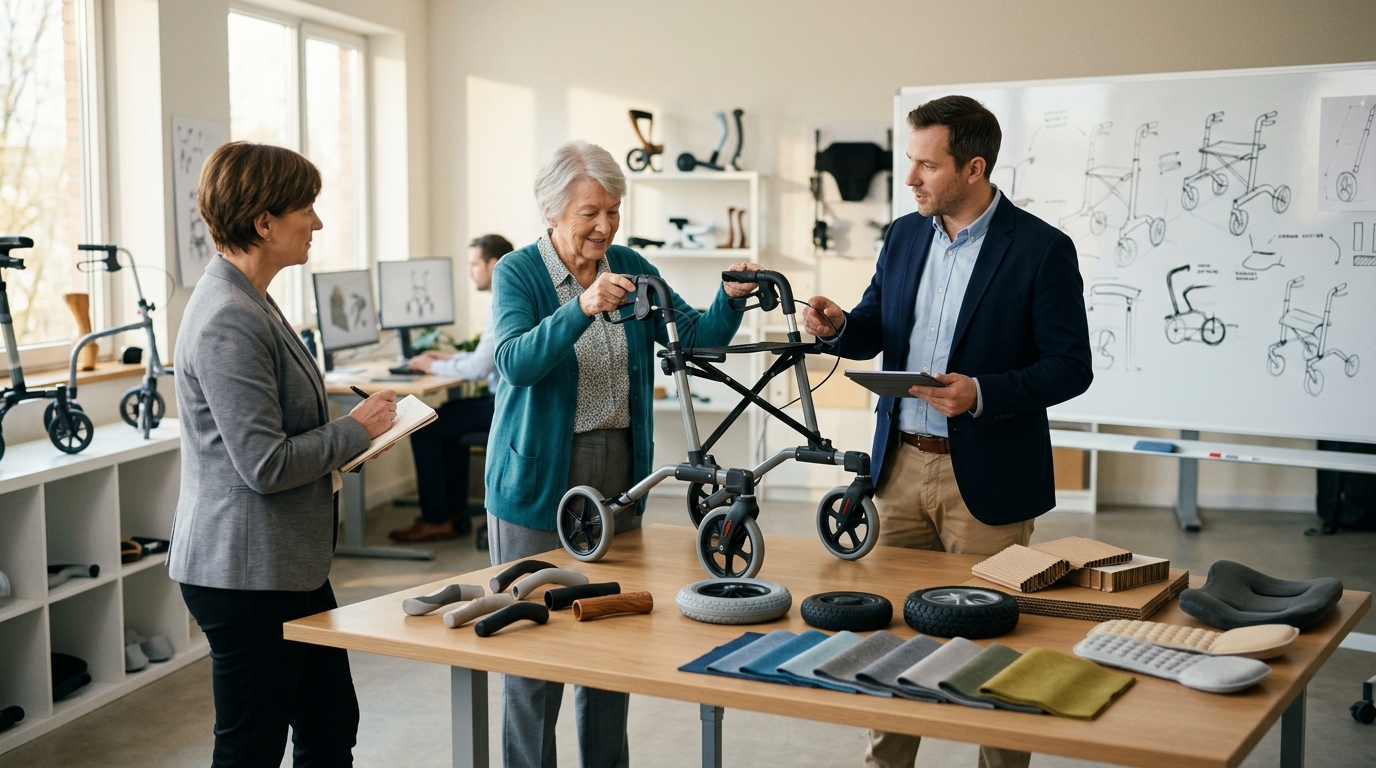
YOYI CARE supports OEM/ODM customization, and buyers can use the company’s medical device OEM ODM service when they need private-label planning across elderly care categories. The practical question is scope. A logo on a wheelchair is simple. A new frame change, bed rail change, or oxygen concentrator housing change needs more review because it may affect testing, documentation, tooling, or regulatory files.
A sensible private-label roadmap looks like this:
1. Pick 4 to 6 launch SKUs across daily elderly care needs.
2. Lock the brand name, logo placement, and carton style.
3. Confirm instruction sheet languages and importer label rules.
4. Test packaging with sample cartons before the first bulk order.
5. Keep structural changes out of the first order unless the business case is clear.
6. Build spare-part naming into the first product file.
Wheelchairs and walkers usually allow visible brand work without heavy engineering change. Nursing beds may need accessory-level planning: mattresses, side rails, remotes, casters, IV pole options, and bed-end design. Bath chairs and commodes can carry color and packaging changes, but their safety logic should stay clean. Oxygen concentrators need the strictest file discipline because power, labeling, filters, alarms, and service expectations carry more risk.
Private-label buyers often ask for too much too early. They want a new color, a different armrest, a custom carton, a new manual, a changed caster, and a new product name in the same first order. That sounds efficient on a spreadsheet. In real sourcing, it creates five chances for delay and ten chances for a mismatch.
Start with the SKU that sells.
Then improve the line after you know which channel responds. A distributor selling to care homes may learn that nursing bed accessories drive profit. An importer selling through pharmacies may find that foldable walkers and bath chairs repeat faster. A hospital supplier may need fewer SKUs but tighter documents and spare parts.
YOYI CARE’s 60+ patent references are useful when buyers want a supplier with product development depth, but patents don’t remove the need for sample review. Ask for samples in the exact configuration you plan to sell. Check the carton, manual, label, accessory bag, surface finish, folding action, brake feel, and user-facing adjustments. Five minutes with a sample tells you things a quote sheet hides.
Home Medical Equipment Manufacturer Quality Compliance Workflow
Quality control for elderly care equipment has to match the person using the product. A distributor buying bath chairs should care about wet-floor stability. A distributor buying wheelchairs should care about brake reach, footrest locking, and caster movement. A distributor buying nursing beds should care about remote controls, bed height movement, rail behavior, and caster locks. Different products need different QC points.

The mistake is using one generic inspection sheet for the whole order.
Build a workflow by product category and order stage. Before sampling, define intended channel and target market. During sample review, check usability and packaging. Before production, lock artwork, model names, accessory lists, and carton marks. During production, inspect dimensions, finishing, fitting, and function. Before shipment, confirm quantity, cartons, labels, manuals, spare parts, and export files.
| Stage | Buyer Action | Supplier Output |
|---|---|---|
| RFQ | Share market, channel, and target product families | Category quote with model differences |
| Sample | Test real use, packaging, labeling, and manual quality | Corrected sample notes and photos |
| Pre-production | Freeze logo, carton, labels, and accessory list | Approved production file |
| Production | Request inspection plan by product type | QC photos or inspection report |
| Pre-shipment | Check cartons, quantities, manuals, and documents | Final packing list and file set |
| After-sales | Track defects by SKU and part name | Replacement plan and root-cause reply |
For oxygen concentrators, the workflow should be stricter. Confirm whether the product is suitable for your destination market and channel, and review the documentation with qualified regulatory support. A general elderly care distributor may sell bath chairs and commodes with a simpler process, but respiratory equipment needs a more formal gate. If your market requires local registration, plan that work before you accept customer deposits.
For nursing beds, inspect both the product and the service plan. A bed has moving parts, electrical parts, and accessories that can be lost or damaged. Ask how spare remotes, actuators, casters, bed rails, and hardware kits are named. If your after-sales team can’t identify a replacement part from a photo, the first customer complaint becomes a long message chain at midnight (usually when nobody wants to solve it).
For wheelchairs, walkers, commodes, and bath chairs, use real-user checks. Can an older adult grip the armrest? Can a caregiver fold the walker without pinching fingers? Does the commode bucket remove without tilting awkwardly? Does the bath chair stay steady when water is present? Product pages rarely answer those questions. Samples do.
Quality also includes language. If your market needs Spanish, Arabic, French, or English manuals, do not leave translation until the last week. Product terms must stay consistent across carton, manual, label, invoice, and spare-part sheet. A “commode chair” on one file and “toilet chair” on another may seem minor, but customs teams, hospital buyers, and after-sales staff notice naming drift.
Home Medical Equipment Manufacturer Distributor Buying Checklist
Start with the channel, then build the portfolio. A hospital supplier, pharmacy distributor, home-care retailer, and private-label medical equipment brand should not buy the same product mix. The product categories may overlap, but the depth, documentation, packaging, and service expectations differ.
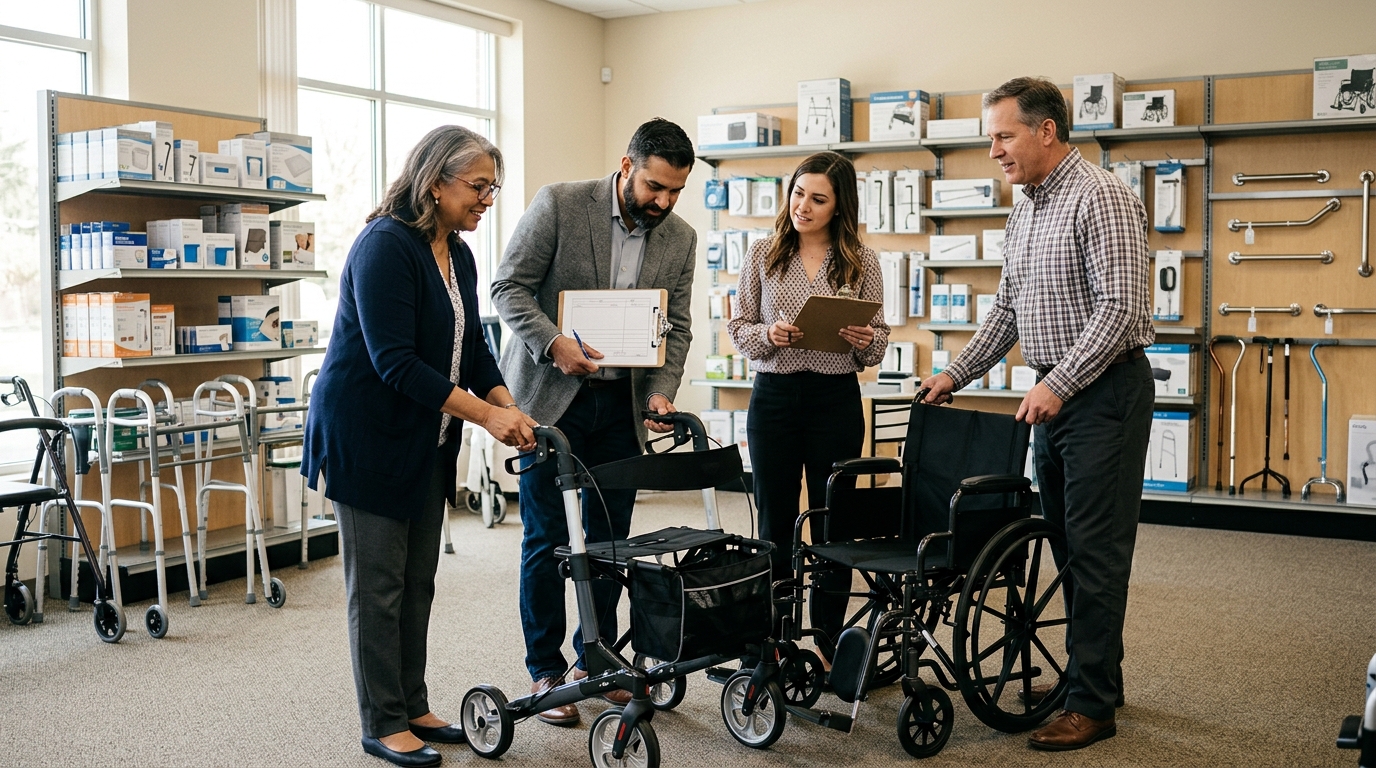
A practical first order for a new elderly care distributor might include manual wheelchairs, foldable walkers, commode chairs, bath chairs, and one nursing bed configuration. Leave oxygen concentrators for a separate review unless your team already handles medical device registration, service, and local compliance. This works better because it lets you test daily living categories first while keeping higher-risk respiratory equipment under proper review.
Use this buying checklist before approving a supplier:
- Confirm product families: wheelchairs, nursing beds, oxygen concentrators, commodes, walkers, bath chairs.
- Request current certificates and product scopes by SKU.
- Ask which OEM/ODM changes are cosmetic, structural, electrical, or regulatory.
- Review sample packaging, manual language, labels, and carton marks.
- Build a spare-part list before shipment, not after complaints.
- Keep one owner for file control inside your buying team.
- Track defects by SKU, batch, part name, and customer channel.
Distributors also need to decide when one supplier is enough. One manufacturer can cover a large share of an elderly care portfolio when the supplier has category knowledge, document discipline, and export experience. Splitting suppliers makes sense when a product category has special regulatory risk, a different service model, or a price band your main supplier cannot match.
Don’t split suppliers just to save a few dollars on one walker. The extra work can eat the savings: second sample set, second artwork file, second inspection plan, second shipping schedule, second after-sales path. Split suppliers when there is a clear business reason, such as oxygen concentrator registration needs, a hospital bed tender spec, or a local distributor requirement tied to a specific standard.
Here is a direct buying sequence that works for most B2B elderly care programs:
1. Define your channel: hospital, care facility, importer, pharmacy, home-care shop, or private-label brand.
2. Pick the first product cluster: mobility, bedroom care, toileting, bathing, or respiratory support.
3. Request samples for the exact models you plan to sell.
4. Review product documents before final pricing talks.
5. Approve packaging and manuals with your local sales team.
6. Place the first order with a narrow SKU set.
7. Expand after tracking sales, defects, and after-sales workload for one shipment cycle.
The final step is the one buyers skip. Track what happens after the goods arrive. Which wheelchair model sells first? Which bath chair gets the most questions? Which nursing bed accessory is misunderstood? Which carton arrives damaged? Which manual page creates support messages? Your second order should be based on that evidence, not only on what looked good in a catalog.
FAQ
Which equipment sells together?
Wheelchairs, walkers, commodes, bath chairs, and nursing beds often sell together because they cover daily mobility, toileting, bathing, and bedroom care. Oxygen concentrators can fit the same elderly care portfolio, but distributors should review medical device registration and service duties first.
Are oxygen concentrators hard to source?
Oxygen concentrators are harder to source than commodes or walkers because documentation, labeling, power requirements, service parts, and market rules carry more weight. Treat respiratory equipment as its own sourcing lane, especially when selling to hospitals or licensed medical distributors.
What certifications should distributors request?
Ask for current SKU-level documents, product scope, certificate holder details, and destination-market relevance. ISO 13485, CE, and FDA-related references are useful, but buyers should confirm the exact model coverage before using any document in tenders or registration work.
Can one supplier cover OEM?
One supplier can cover OEM work when the changes are branding, packaging, manuals, color planning, or accessory pairing. Structural, electrical, or intended-use changes need closer review because they may affect testing, documentation, tooling, and local regulatory responsibilities.
When should distributors split suppliers?
Split suppliers when one category needs special compliance, service skills, or a price band your main supplier can’t support. Keep one supplier for connected elderly care products when document control, packaging, after-sales, and product logic are stronger together.
If you’re comparing home medical equipment manufacturer options for an elderly care portfolio, send YOYI CARE your target market, sales channel, preferred product categories, branding needs, and documentation requirements. YOYI CARE can help you map wheelchairs, nursing beds, oxygen concentrators, commodes, walkers, and bath chairs into a practical B2B sourcing plan.


