

A reliable china electric wheelchair factory should be screened on regulatory documents, battery safety, QC proof, payment terms, and export handoff before you compare unit price. This guide gives importers a practical shortlist process: verify the factory, approve samples, write the 30% deposit terms, inspect the batch, then ship to your port or warehouse.
China Electric Wheelchair Factory Criteria
Choose a China electric wheelchair factory by checking four things first: medical device documents, real production capability, repeatable QC records, and export support. Price matters, but it comes after the factory proves it can build the same wheelchair twice, label it correctly, pack the battery safely, and support you after delivery.
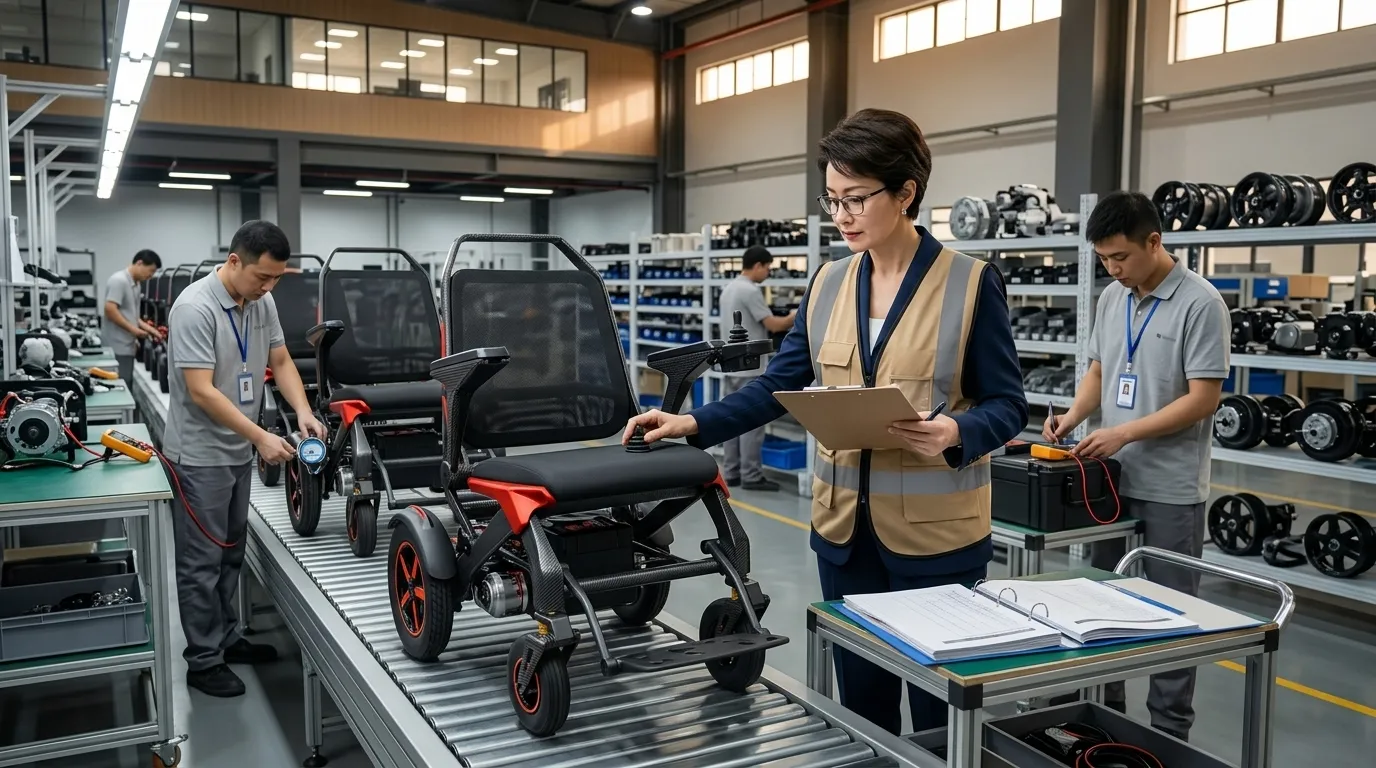
A weak shortlist usually starts with photos. A stronger shortlist starts with documents and process. Ask for the business license, ISO13485 certificate, CE-related documents for EU sales, FDA-related registration or listing evidence for U.S. sales where applicable, battery transport documents, recent inspection records, and model-level specifications. Then match every document to the exact wheelchair model you plan to buy.
Electric wheelchairs are medical mobility devices, so the regulatory detail is not decoration. In the United States, the Electronic Code of Federal Regulations lists a powered wheelchair under 21 CFR 890.3860 as a battery-operated medical device for people restricted to a sitting position, classified as Class II. For Europe, the European Commission medical device regulations explain that Regulation (EU) 2017/745 has applied to medical devices since May 26, 2021. Your importer or regulatory consultant still needs to confirm the exact route for your market.
| Shortlist item | What to ask for | Red flag |
|---|---|---|
| Factory identity | Business license, factory address, export name | The seller refuses a video audit |
| Model traceability | Model number, spec sheet, user manual | Documents use a different model code |
| Quality system | ISO13485 certificate and QC flow | Only a generic ISO9001 file is shared |
| Export readiness | Battery reports, carton marks, HS code support | Battery paperwork appears after shipment booking |
YOYI CARE has manufactured medical equipment since 2013, with OEM/ODM projects, certification references, warranty support, and more than 60 patents listed across brand materials. That experience matters because importers rarely lose money on one spec line. They lose money when the spec, label, carton, invoice, battery document, and after-sales plan don’t match.
If you’re also comparing manual wheelchairs, rollators, and mixed mobility suppliers, the broader wheelchair manufacturer in China sourcing checklist is a better starting point for your first supplier screen.
Certification Documents To Request
Ask for documents by model, not by product category. “We have CE” is too loose. “Please send the CE declaration or certificate, test report, user manual, label artwork, and technical file index for model YHWT-001” is harder to fake and easier for your compliance team to review.
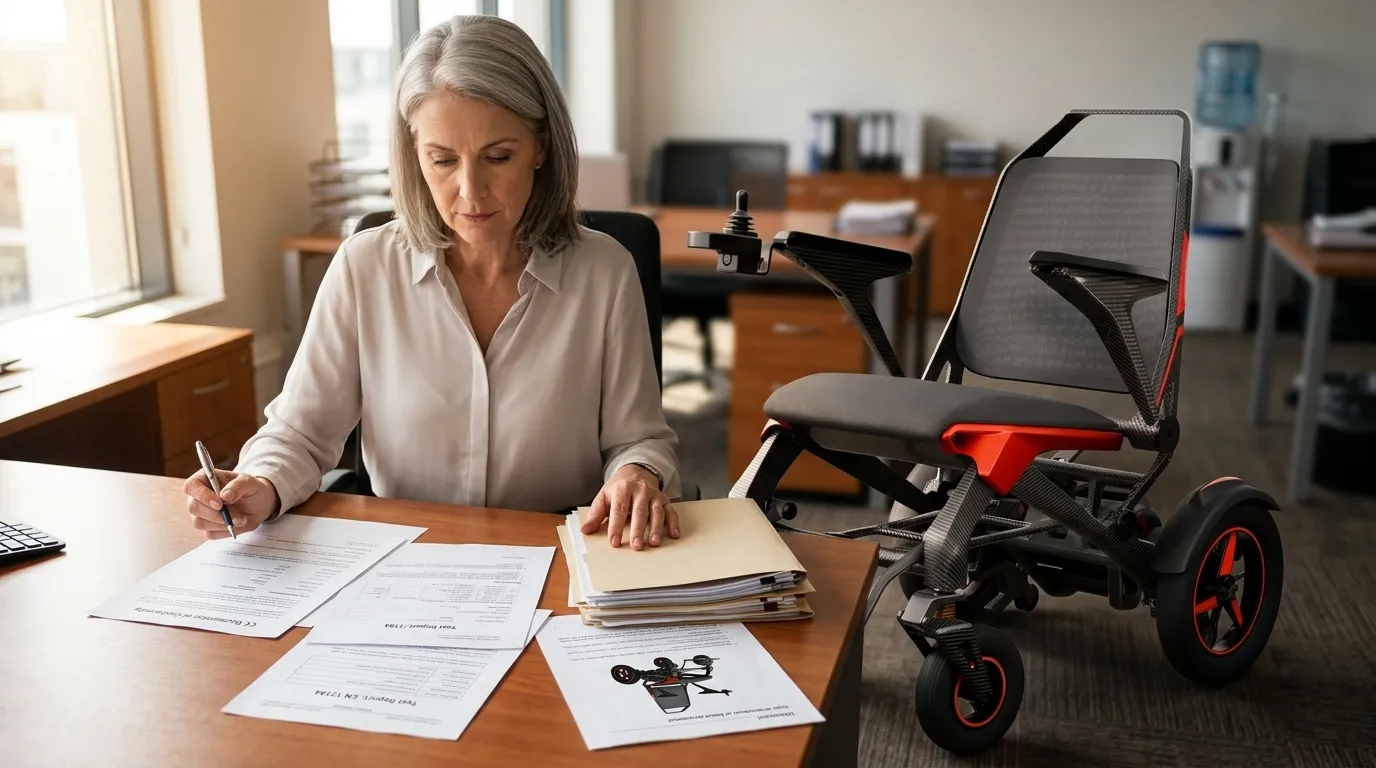
For an electric wheelchair order, your document pack should usually include:
- Business license and export registration details
- ISO13485 certificate for the manufacturer’s quality system
- CE declaration or CE certificate where relevant to your market
- FDA-related establishment, listing, or clearance documentation where relevant
- Battery UN38.3 test summary, MSDS, and transport paperwork
- Product specifications, user manual, warranty terms, and spare parts list
- Label artwork, carton marks, serial number plan, and warning labels
- Final inspection report tied to the production lot
Don’t accept a decorative “FDA certificate” as the whole answer. For U.S. imports, your team should verify the legal pathway, establishment information, and device status against official FDA systems or through a qualified regulatory consultant. For EU imports, confirm the manufacturer, EU authorized representative if needed, device classification, declaration of conformity, and labeling language.
This is where an experienced custom electric wheelchair manufacturer saves time. The factory should know which documents belong to the wheelchair, which belong to the battery, and which belong to the shipment. If the salesperson sends one PDF and says “all okay,” slow down.
A practical check: ask the factory to mark the same model code across the quotation, sample invoice, manual, label, inspection report, packing list, and carton mark. One mismatch can delay customs clearance or trigger a distributor relabeling mess later.
Payment Terms And Contracts
For a first bulk order, the cleanest baseline is usually 30% deposit by T/T after the purchase order and contract are signed, then 70% balance after passed QC and before shipment. Bigger repeat orders may use a letter of credit, staged payments, or balance against a bill of lading copy, depending on your risk tolerance and banking setup.

Avoid 100% upfront payment with a new factory. It removes your strongest control point: the final inspection.
Put the payment terms in a sample contract before mass production. Keep the language plain. Your lawyer can refine it, but the commercial logic should already be clear to both sides.
| Contract clause | Put this in writing |
|---|---|
| Product scope | Model number, frame material, motor, controller, battery type, charger plug, seat width, color, logo placement |
| Sample approval | Mass production must match the signed sample, approved photos, and final spec sheet |
| Payment | 30% deposit after contract, 70% balance after passed QC and before shipment |
| QC right | Buyer or third-party inspector can inspect before balance payment |
| Defect handling | Rework, replacement parts, credit note, or shipment hold for major defects |
| Warranty | Warranty period, excluded damage, spare parts supply, response time |
| IP and branding | Buyer logo, private-label packaging, manuals, and market restrictions |
| Shipping terms | Incoterms, port, warehouse address, pallet rules, and required export documents |
A sample order should have its own smaller contract too. If you’re testing a foldable model for dealer demos, tie the sample to the later bulk spec. For example, if you evaluate a foldable aluminum electric wheelchair sample with a specific battery, joystick, charger, and carton, don’t let the bulk order quietly switch to different components.
Private-label buyers need one extra clause: change control. If the factory changes the motor, controller, battery cell supplier, charger, firmware, frame coating, carton strength, or manual, you should approve it before production continues. Quiet substitutions are where warranty claims begin.
Samples, QC, And Warranty
A china electric wheelchair factory should pass sample review before price negotiation gets serious. The sample is where you check the wheelchair as a product, not just as a line on a spreadsheet: folding action, turning radius, brake response, joystick feel, seat comfort, weld finish, packaging strength, manual clarity, and charger compatibility.
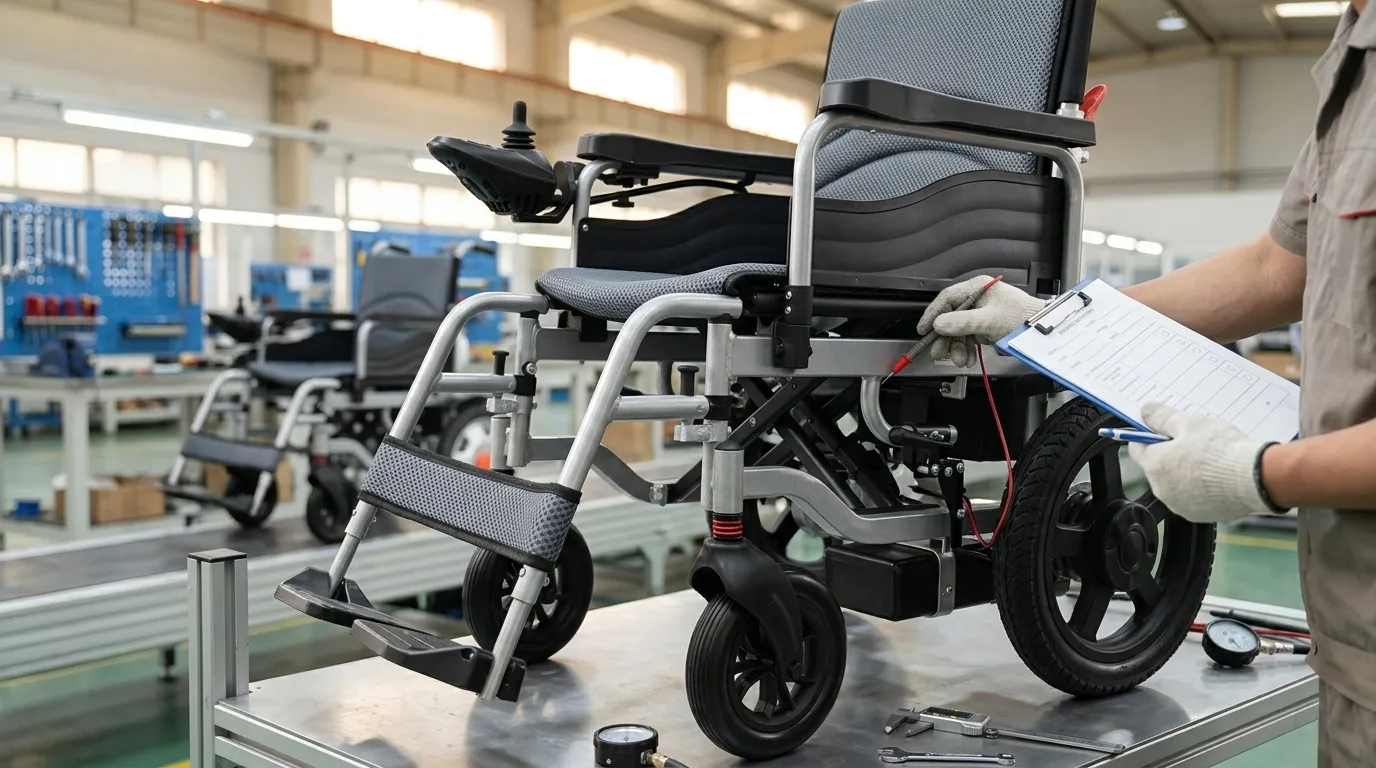
For B2B buyers, one sample is rarely enough. Order a sales sample for your team, then run a pre-production confirmation sample if you change the logo, battery, seat width, carton, or manual. Care-facility procurement teams should also test the wheelchair on ramps, thresholds, elevators, and tight corridors. The showroom floor is too kind.
Use QC checkpoints that match how electric wheelchairs fail in real use:
| QC stage | What to verify |
|---|---|
| Incoming materials | Frame parts, motors, controller, battery, charger, tires, upholstery |
| In-process check | Welding, wiring, folding mechanism, brake assembly, fasteners |
| Functional test | Forward, reverse, turning, braking, charging, indicator lights |
| Final inspection | Appearance, labeling, manual, accessories, carton drop condition |
| Pre-shipment review | Quantity, serial numbers, packing list, battery documents |
Warranty support is part of sourcing, not an afterthought. Ask for the spare parts catalog before you place the bulk order. A distributor can wait for a replacement armrest. A hospital account won’t wait calmly for a controller answer that takes 12 days.
YOYI CARE’s OEM/ODM work usually starts with the use case: retail distribution, private-label catalog, care facility fleet, or medical equipment brand expansion. Each one needs different tradeoffs. A lightweight folding chair works better for dealers selling home mobility, while a heavier steel model may suit budget-sensitive tenders where durability and cost control matter more than trunk lifting.
If your shortlist includes both factories and trading companies, this electric wheelchair supplier vs factory comparison explains what distributors should compare before bulk orders.
Shipping To Port Or Warehouse
Shipping electric wheelchairs is partly freight work and partly battery paperwork. Decide early whether you want FOB China port, CIF destination port, DDP warehouse delivery, or shipment to your forwarder’s China warehouse. Each option changes who controls booking, customs documents, insurance, and local delivery.
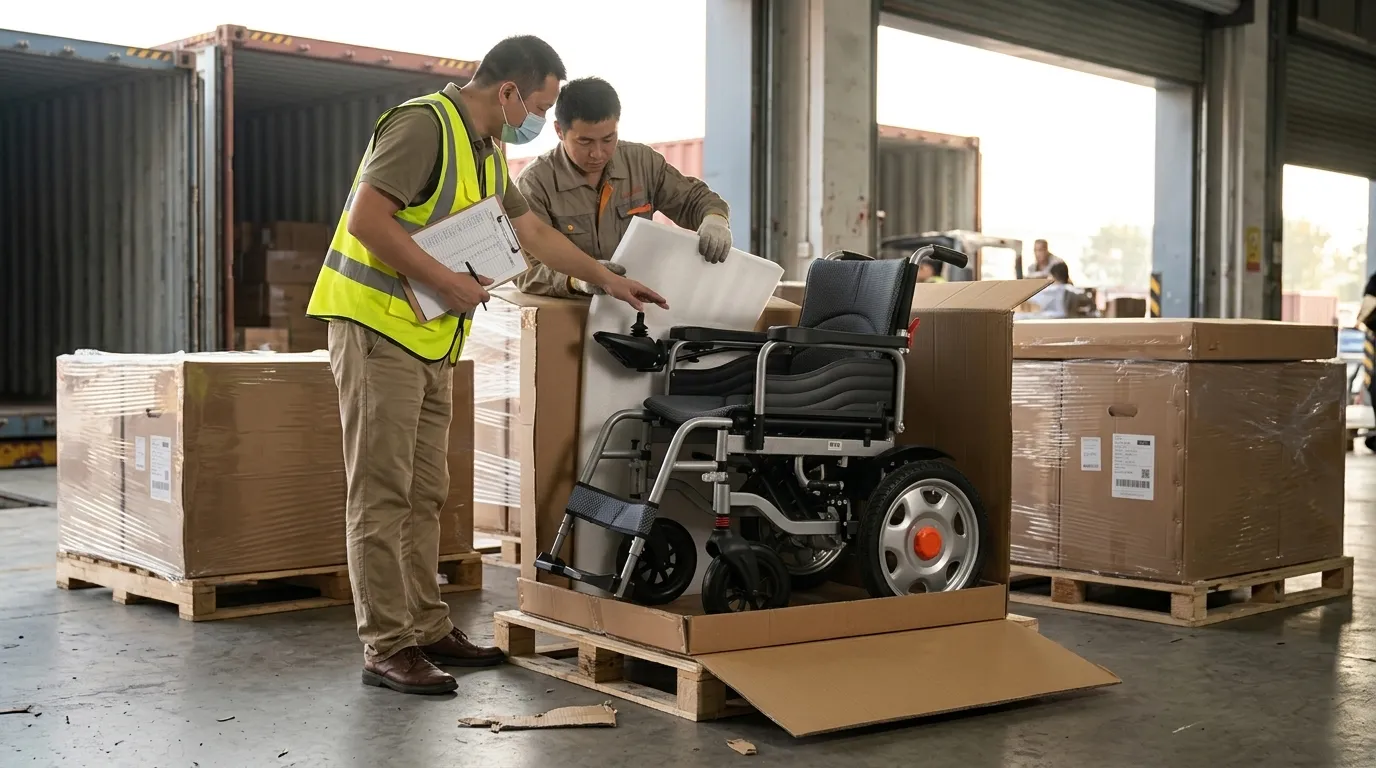
FOB works well for experienced importers with their own forwarder. DDP can help small buyers, but it hides cost details and gives you less control when customs asks questions. For medical equipment distributors, FOB or FCA is usually cleaner once order volume becomes steady.
| Shipping choice | Best for | Watch closely |
|---|---|---|
| FOB China port | Importers with forwarders | Port, cutoff date, export documents |
| FCA China warehouse | Buyers consolidating goods | Handover time and warehouse rules |
| CIF destination port | Buyers needing freight included | Local charges after arrival |
| DDP warehouse | Smaller trial orders | Customs responsibility and tax clarity |
Before shipment, confirm the commercial invoice, packing list, bill of lading details, carton marks, HS code proposal, battery documents, inspection report, and insurance if applicable. If you ship to an Amazon-style warehouse, dealer warehouse, or hospital tender warehouse, confirm pallet height, barcode labels, carton strength, delivery appointment rules, and whether the receiving team allows mixed SKUs.
One small detail saves arguments: photograph the loaded container or pallets, including carton marks and seal number. It takes five minutes. It can settle a claim weeks later.
Factory Comparison Checklist
When two suppliers look similar, compare how they answer hard questions. A strong factory gives exact model data, names the tradeoff, and tells you when a request may create certification, warranty, or shipping risk. A weak seller agrees to everything before checking with engineering.
Use this final filter before you place a deposit:
- Can the factory explain the difference between the quoted motor, controller, battery, charger, and frame options?
- Do all certificates and reports match the exact model or product family?
- Can the factory support OEM/ODM packaging, manuals, labels, and spare parts without changing the approved sample?
- Is the 30% deposit tied to a signed contract, approved sample, and frozen spec sheet?
- Is the 70% balance tied to passed QC before shipment?
- Are battery transport documents ready before booking freight?
- Does the warranty plan name parts, response process, and claim evidence?
- Can the factory ship to your port, forwarder warehouse, or destination warehouse with clean documents?
For a shortlist, pick the factory that gives fewer surprises. The cheapest quote often wins the first spreadsheet. The better factory wins when your distributor asks for the same model, same label, same carton, and same spare parts six months later.
FAQ
How do I verify a factory?
Ask for the business license, factory address, live video tour, ISO13485 certificate, model-level documents, and recent QC records. Then compare the company name across the quotation, certificates, invoice, packing list, and export documents.
What payment term is normal?
For a first bulk order, 30% deposit and 70% balance after passed QC is a common structure. Larger repeat orders may use a letter of credit or staged payment terms.
Can factories ship to warehouses?
Yes, many factories can ship to a port, forwarder warehouse, or overseas warehouse through a freight partner. Confirm Incoterms, battery paperwork, carton marks, pallet rules, and delivery appointment needs before production finishes.
Send YOYI CARE your target market, preferred frame type, branding needs, and first shipment plan. Our team can help you review electric wheelchair model options, OEM/ODM details, certification documents, QC steps, and export handoff before you commit to a bulk order.


