

A 3-function electric nursing bed is usually the better buy for home care, basic ward use, and price-sensitive distribution programs; a 5-function electric nursing bed fits nursing homes, hospitals, and premium private-label lines that need height adjustment, tilt positioning, or easier caregiver handling. For B2B buyers, the right choice depends less on “more functions” and more on the patient profile, caregiver workflow, room setup, compliance needs, and after-sales burden.
Electric Nursing Bed Comparison
| Buying question | 3-function bed | 5-function bed |
|---|---|---|
| Core movements | Back lift, leg lift, overall height or back/leg combined control depending on design | Back lift, leg lift, height adjustment, Trendelenburg/reverse tilt or lateral/turning function depending on model |
| Best buyer fit | Home care channels, entry-level nursing homes, general distributors | Hospitals, mid- to high-end care homes, rehab centers, premium OEM/ODM projects |
| Caregiver workload | Lower than manual beds, but repositioning options are limited | Better for frequent repositioning, transfers, cleaning, and care routines |
| Retail positioning | Easier to sell on price and basic comfort | Easier to sell on clinical workflow, safety, and long-term care value |
| Main drawback | Can feel under-specified for facilities with heavier care needs | Higher cost, heavier structure, more parts to service |

A 3-function electric nursing bed covers basic comfort and care tasks: raising the back, adjusting the legs, and changing bed height or coordinating body position. A 5-function model adds positioning range, often with tilt, turning, or advanced height control, which makes it stronger for facilities handling transfers, pressure-care routines, and higher-dependency residents.
Start with the care setting.
If your customer is a home-care retailer selling to families, the 3-function model may win because the buyer can understand it in 30 seconds. Raise the back for meals. Raise the legs for comfort. Adjust height for safer transfers. Done.
If your customer is a nursing home with 80 rooms and two caregivers covering a night shift, the 5-function model has a different value. The question becomes: how many times per shift does a caregiver bend, reposition, clean, transfer, or check a resident?
That changes the procurement math.
YOYI CARE has supplied medical and elderly-care equipment since 2013, with OEM/ODM customization and certification references including ISO13485, CE, and FDA-related documentation shown on our official materials. For distributors and private-label brands, that matters because the bed isn’t a one-time product sale. It becomes spare parts planning, manuals, cartons, labels, motor choices, controller layouts, and the awkward phone call when a buyer asks why two beds that look similar have very different prices.
For broader product-line planning, it also helps to review the product family from a custom nursing bed manufacturer rather than comparing isolated SKUs from screenshots.
Bed Functions Buyers Need
“Three functions” and “five functions” sound neat on a quotation sheet. They aren’t always neat in real life.
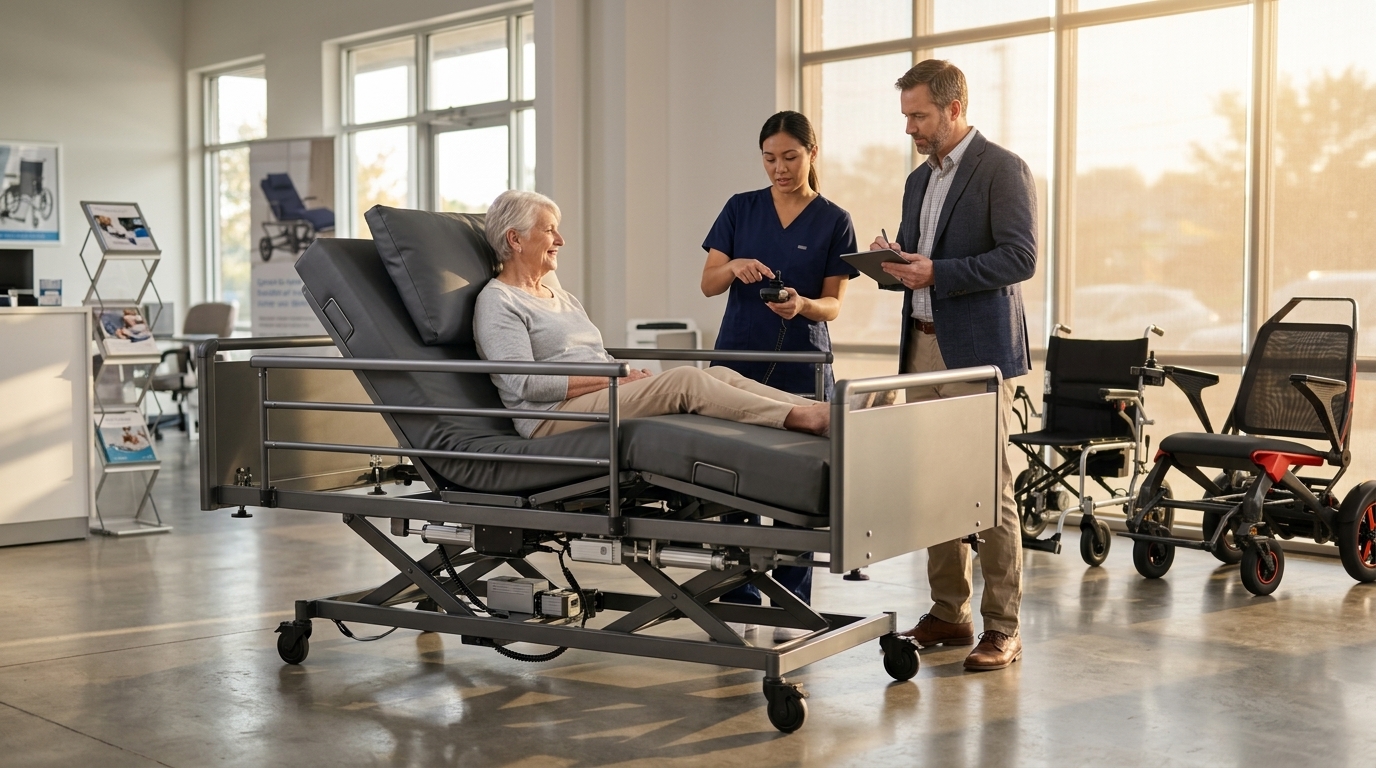
One supplier may count back lift, leg lift, and height adjustment as 3 functions. Another may count back lift, knee lift, and back-knee linkage. A 5-function bed might include Trendelenburg and reverse Trendelenburg. Another 5-function bed might include left-right turning. Before you compare prices, compare the actual motions.
| Function | What it does | Why B2B buyers care |
|---|---|---|
| Back lift | Raises the upper body | Meals, reading, breathing comfort, caregiver access |
| Leg lift | Raises knees or lower legs | Comfort, positioning, reduced sliding when paired with back lift |
| Height adjustment | Raises or lowers the whole platform | Transfers, caregiver posture, cleaning access |
| Tilt positioning | Angles the whole bed head-up or foot-up | Facility protocols, care positioning, premium specification |
| Turning function | Rotates or tilts the patient surface left/right | Repositioning support in higher-dependency care |
Back lift is the easiest feature to sell because every buyer has seen it. A resident sits up to eat. A family member raises the head section to talk. A caregiver adjusts the bed before feeding. No long explanation needed.
Leg lift is less glamorous, but it changes comfort. In cheaper builds, the knee section rises while the lower leg area stays simple. In better builds, the geometry feels smoother and the patient doesn’t slide down as easily when the back is raised. Ask for the bed angle range, then ask how the sections move together. A small detail here can create a lot of complaints after delivery.
Height adjustment is where procurement teams should slow down.
For home care, height adjustment helps with wheelchair transfers and makes caregiving less awkward. For nursing homes and hospitals, it affects nearly every routine: changing sheets, bathing support, wound checks, transfers, fall-risk management, and cleaning under the bed. The U.S. Occupational Safety and Health Administration discusses safe patient handling as a workplace safety issue because manual lifting and awkward postures can injure caregivers (OSHA). A bed that rises to caregiver height isn’t a luxury in a facility. It’s part of the work system.
Tilt and turning functions need more caution.
They can be very useful, especially in higher-care environments. They also add motors, brackets, wiring, controller logic, and service points. If you’re selling into hospitals or advanced nursing homes, that tradeoff makes sense. If you’re building a low-cost catalog for mixed home-care buyers, those features may raise the price without raising conversion.
A quick procurement test:
- If the buyer says “comfort bed for elderly care,” start with 3-function.
- If the buyer says “care staff,” “transfer,” “night shift,” or “bedridden residents,” quote 5-function.
- If the buyer asks for OEM branding, cartons, manuals, and mixed container planning, compare both.
- If the buyer only asks for the lowest price, define the function list in writing before you quote.
This is also where a previous sourcing checklist helps. If your team hasn’t already mapped supplier quality, warranty handling, and documentation flow, use this related guide on choosing a hospital bed manufacturer before locking a bed series.
Procurement Scenarios Matter
A distributor in Texas and a nursing-home group in Poland may both ask for “electric beds,” but they are buying two different things.

The distributor wants a product that sells cleanly. The nursing-home group wants fewer problems after installation. The OEM brand wants stable appearance, labeling, packaging, and repeat orders. The hospital wants compatibility with care routines and internal procurement rules.
One product name. Four buying jobs.
| Buyer type | Better default | Reason |
|---|---|---|
| Home-care distributor | 3-function | Easier price point, simple explanation, lower service complexity |
| Nursing-home operator | 5-function | Better for transfers, cleaning, and frequent repositioning |
| Hospital procurement team | 5-function | Wider positioning range and caregiver workflow support |
| Private-label brand | Both tiers | Entry model plus premium model gives sales teams more control |
| Importer building a catalog | 3-function first | Lower barrier for market testing, then add 5-function after demand is proven |
Home care is the cleanest case for a 3-function bed.
Picture the buyer: an adult daughter ordering equipment for her father after discharge. She isn’t comparing motor torque or side-rail mechanisms. She wants him to sit up, get in and out of bed, and sleep more comfortably. If the sales page is too technical, she leaves. If the bed looks too medical, she hesitates. For that channel, the 3-function bed often hits the right balance.
Nursing homes are less forgiving.
A bed that looks affordable on a spreadsheet can become expensive when caregivers complain about transfer height, side-rail handling, mattress fit, or control placement. In facilities, small frictions repeat hundreds of times. Raise the bed. Lower the bed. Lock the castors. Move the resident. Clean the frame. Reset the position. Do it again after lunch.
This is where 5-function beds earn their space.
Hospitals usually need a tighter specification process. Bed dimensions, safe working load, side-rail style, brake system, motor brand, emergency lowering options, IV pole compatibility, nurse control, and infection-control cleaning all matter. A 3-function bed may still fit a lower-acuity ward or step-down setting, but hospital buyers usually ask more from the bed frame and control system.
For private-label healthcare brands, the answer is often a two-tier range. Use a 3-function model as the “standard electric care bed” and a 5-function model as the “advanced care bed.” Keep the visual family similar: same headboard style, same color scheme, same side-rail language, same caster look. Buyers feel like they’re choosing within a system, not jumping between unrelated factories.
A small warning: don’t copy hospital wording into a home-care catalog. Families don’t search like procurement officers. They ask, “Can Dad sit up?” and “Will this fit in the room?” Procurement teams ask, “What is the motor warranty policy?” and “Can you provide documentation for our market?” Same product, different language.
If you’re still defining the category for your sales team, the explainer on types of nursing bed can help separate home-care, nursing-home, and hospital use cases without turning the catalog into a spec dump.
Controls And Safety Details
The handset looks like a small part. It isn’t.

A confusing controller creates support calls, especially in home-care channels where the end user may be tired, stressed, or unfamiliar with medical equipment. A controller with clear icons, logical button grouping, and a lockout option can reduce mistakes. For care facilities, staff controls may matter even more than patient controls because staff need to set safe positions quickly.
Common control options include:
- Wired handset for simple home-care and distributor models
- Nurse control panel for facility and hospital use
- Foot pedal or side controls for selected care tasks
- Lockout function to prevent unsafe or unwanted movement
- Battery backup option for power interruptions
For 3-function beds, a wired handset is often enough. Keep the icons readable. Make the cable length practical. Use raised buttons that older users can feel. A flat, tiny controller may look modern in a catalog photo, but it can frustrate a 78-year-old user at 2 a.m.
For 5-function beds, controller logic becomes more serious. If the bed has tilt or turning, the control layout should separate basic comfort adjustments from advanced positioning. This reduces accidental operation. It also helps distributors train dealers and facility staff without writing a small novel.
Side rails deserve equal attention.
The U.S. Food and Drug Administration has published safety information related to hospital bed systems and entrapment risks, including discussion of rails, mattresses, and gaps in bed systems (FDA). For B2B procurement, that means you can’t treat the frame, mattress, and rails as unrelated items. Bed width, rail gap, mattress thickness, and platform movement should be checked together.
Castors and brakes are another quiet source of complaints.
A home-care bed may only move during room setup or cleaning. A nursing-home bed may move more often. A hospital bed may be pushed across corridors, through elevators, and around other equipment. The caster diameter, brake feel, central brake option, and turning radius all affect how “solid” the bed feels after delivery.
Then there is cleaning.
Flat surfaces clean faster. Open spaces under the bed help staff reach dust and spills. Complex undercarriages may be stronger or more capable, but they can collect debris if the design is careless. Ask for photos from below the bed, not only the polished front angle. Procurement teams rarely do this. They should.
A practical B2B inspection list:
| Component | Ask this before ordering |
|---|---|
| Handset | Are icons clear in the target market language? |
| Motors | Which functions use separate motors? |
| Side rails | What rail type is available for home care, facility, or hospital use? |
| Castors | Are brakes individual or central? |
| Mattress fit | What mattress size and thickness are recommended? |
| Cleaning | Can staff access the under-bed area easily? |
YOYI CARE supports OEM/ODM customization, so control labels, packaging language, side-rail choices, headboard style, and market-specific product positioning can be discussed during product planning. We don’t recommend changing everything at once. Change what your buyer will notice, what your regulations require, and what your service team can support.
Cost, Specs, And Tradeoffs
A 5-function bed costs more because it usually has more motors, more structural parts, more controller logic, and a heavier frame. That part is obvious. The less obvious part is where the extra cost returns value.
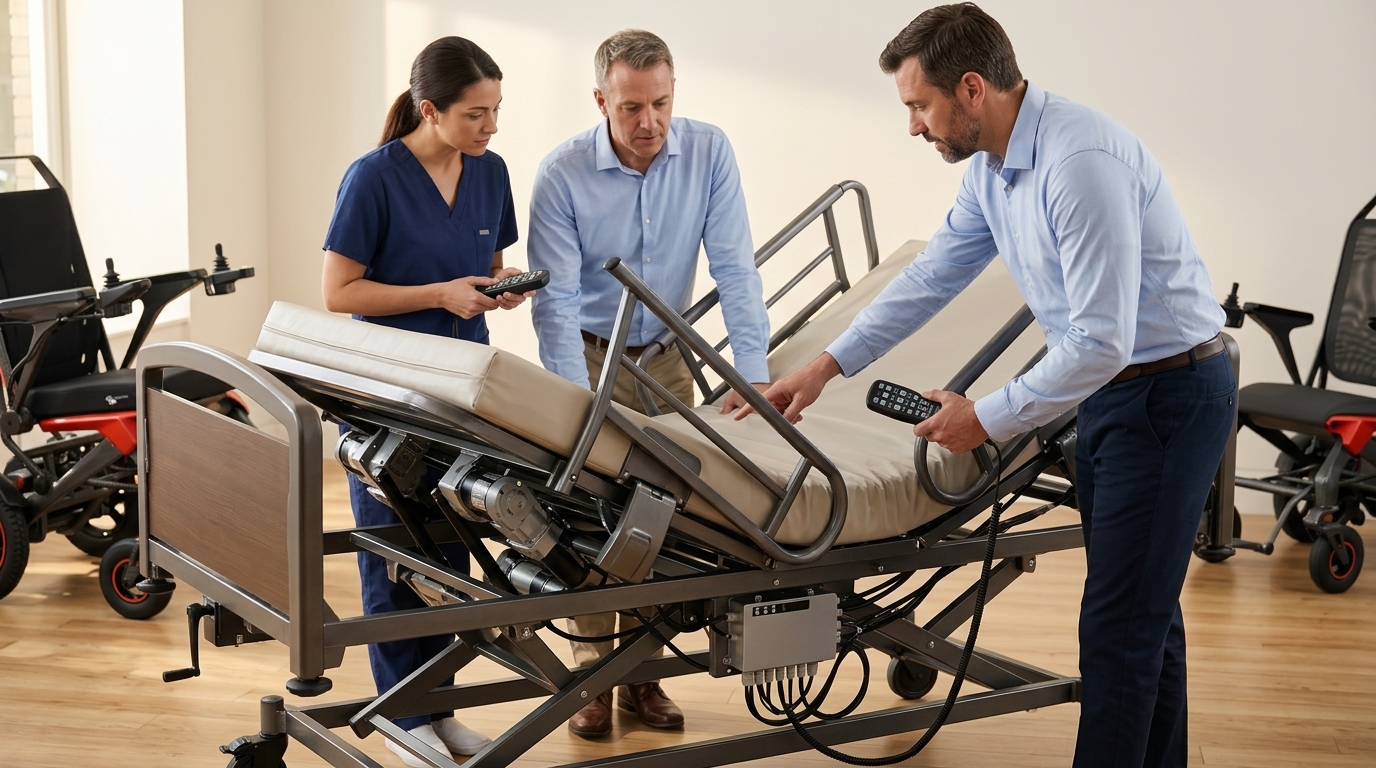
If a 5-function bed reduces caregiver strain, supports easier transfers, and fits higher-dependency residents, the facility may accept the higher purchase price. If the same bed sits in a low-acuity home-care showroom next to a cheaper model, it may look overbuilt.
That word matters: overbuilt.
Procurement teams often ask for the “best” model, then reject the quote because the price lands outside the market. A better brief is tighter: “We need a 3-function electric bed for home-care distributors in the United States, with wood-look head and foot boards, quiet motors, English labeling, and a retail-friendly carton.” That gives the supplier something to build around.
For a 5-function tender, the brief should read differently: “We need a 5-function bed for nursing homes, with height adjustment, tilt positioning, side rails suitable for facility use, brake options, spare parts support, and documentation for import review.”
Same factory conversation. Much better result.
| Spec area | 3-function buying focus | 5-function buying focus |
|---|---|---|
| Frame | Stable and cost-controlled | Stronger structure and smoother motion |
| Motor system | Quiet, reliable basic adjustment | Multiple motors with clear service access |
| Appearance | Home-friendly or light medical style | Facility-grade, cleanable, durable finish |
| Packaging | Retail or distributor-friendly | Project shipment and spare parts planning |
| Documentation | User manual, labels, basic compliance documents | Tender documents, service guides, market files |
| Customization | Branding, color, headboard, carton | Branding plus function configuration and controls |
Importers should also think in product ladders.
A catalog with only 5-function beds may scare off price-sensitive dealers. A catalog with only 3-function beds may lose facility tenders. Two models can do more than five random models if the difference is clear: standard care and advanced care.
Don’t ignore spare parts. Motors, handsets, control boxes, castors, side rails, boards, and actuators should have part names your team can understand. If the supplier uses vague line items like “accessory part,” ask for a clearer list. Your future service team will thank you.
Certification wording needs discipline too. YOYI CARE references ISO13485, CE, FDA, and other certification-related materials on official channels, but buyers should request current documents for the exact product, destination market, and order context. A certificate shown on a website doesn’t replace product-level document review.
Here’s the buying rule I use with B2B teams:
- Buy 3-function when the main value is comfort, basic care, and accessible pricing.
- Buy 5-function when the main value is caregiver workflow, resident handling, and facility-grade positioning.
- Build both when you’re creating a private-label range.
- Ask for function videos before samples, because motion quality is hard to judge from photos.
- Confirm mattress, rail, and control compatibility before final packaging artwork.
One more detail: freight. A heavier 5-function model may change container loading, warehouse handling, and last-mile delivery. If your sales team quotes only the unit cost, margin can disappear in logistics. Ask for packed dimensions and gross weight early.
Supplier Selection Checklist
A good supplier won’t just quote a bed. They will help you define the bed.

For distributors and OEM/ODM managers, the supplier conversation should cover product design, compliance documents, packaging, spare parts, labeling, manuals, and after-sales support. If the supplier only replies with a price and a catalog PDF, you may still have a product. You don’t yet have a sourcing plan.
YOYI CARE was founded in 2013 and holds more than 60 patents across its product development work. For B2B buyers, the point isn’t a fancy number in a brochure. It means the supplier has a deeper product base to draw from when you ask for a headboard change, controller preference, side-rail option, or private-label setup.
Use this checklist before sample approval:
| Checkpoint | Why it matters |
|---|---|
| Function definition | Prevents “3-function” and “5-function” misunderstandings |
| Bed motion video | Shows lift speed, noise, and movement sequence |
| Control layout | Reduces end-user confusion and service calls |
| Rail and mattress match | Supports safer bed-system planning |
| Motor and actuator access | Helps with repair and spare parts |
| Packaging plan | Protects heavy parts during export shipping |
| Manual and labels | Supports import, sales, and end-user operation |
| Spare parts list | Makes after-sales service manageable |
| Market documents | Helps your compliance review before purchase |
| OEM/ODM scope | Defines what can change without creating risk |
For nursing homes and hospitals, ask your sales or clinical contact to simulate a day with the bed. Morning transfer. Meal position. Sheet change. Cleaning. Evening repositioning. Emergency lowering if power fails. If the bed feels awkward in that sequence, the spec sheet won’t save it.
For home-care distributors, test the buying story. Can a salesperson explain the bed in two minutes? Can the end user understand the handset without a training call? Does the bed look acceptable in a bedroom, or does it feel too institutional for family buyers?
For importers, compare landed cost rather than factory price alone. The 5-function model may still be the better margin product if it supports a higher retail price and fewer direct competitors. The 3-function model may move faster but attract more price comparison.
For private-label brands, decide which parts of the design are truly yours. Logo badge? Carton? Manual? Color? Headboard style? Control icon set? A disciplined private-label project changes visible brand elements while keeping the engineering base stable. That is usually the cleaner route for repeat orders.
Before placing a bulk order, request:
- Product specification sheet
- Function video for the exact model
- Packing details with dimensions and weight
- Spare parts list
- Current compliance documents for review
- User manual draft
- Label and carton artwork templates
- Warranty and service terms in writing
A sample bed is worth the freight when you’re building a long-term line. Photos answer appearance questions. Samples answer the annoying questions: Does the brake feel cheap? Does the back section move smoothly? Is the handset easy to press? Does the bed rattle after repeated adjustment?
FAQ
Is 3-function enough for home care?
Yes, a 3-function bed is often enough for home care when the user mainly needs back lift, leg lift, and easier transfers. Choose 5-function only if the patient needs frequent repositioning or caregiver-heavy support.
What makes a 5-function bed better?
A 5-function bed usually adds advanced height, tilt, or turning functions. These features fit nursing homes, hospitals, and higher-dependency care settings where staff reposition patients often.
Which bed is better for distributors?
A 3-function model is usually easier for distributors to sell because the price and benefits are simple. A 5-function model works better as a premium option for facility buyers.
Can YOYI CARE support OEM branding?
Yes, YOYI CARE supports OEM/ODM customization for B2B buyers. Branding, packaging, manuals, color choices, and selected configuration details can be discussed based on the target market.
Are certifications product-specific?
Yes, certification and compliance documents should be checked for the exact product and destination market. Ask for current files during procurement rather than relying only on general website references.
For distributors, importers, hospitals, and private-label medical equipment brands, YOYI CARE can help compare 3-function and 5-function nursing bed options, align the specification with your buyer scenario, and prepare an OEM/ODM plan that fits your market without inventing features your customers won’t use.


