

Choose a hospital bed manufacturer by verifying medical-device quality certification, bed safety documentation, production controls, motor system reliability, spare-parts support, and OEM/ODM fit before you discuss price. For nursing homes and distributors, the best supplier is the one that can prove stable production and after-sales parts, because a failed side rail, handset, or brake becomes your customer’s problem within weeks.
Hospital Bed Manufacturer Checklist
1. Verify ISO 13485, CE/FDA status, and target-market documents.
2. Match bed functions to nursing home use.
3. Review frame material, welding, coating, and guardrails.
4. Audit motors, handsets, brakes, and control boxes.
5. Check QC records, sample testing, packaging, parts, and warranty support.

A low quotation can hide expensive work. You approve a sample, order containers, ship to a distributor, and then the first complaint comes from a care facility: the handset feels weak, the caster brake doesn’t hold well on vinyl flooring, or replacement guardrail parts take too long to arrive. The invoice looked good. The program didn’t.
For B2B sourcing, start with a supplier checklist that separates “factory can sell beds” from “factory can support a bed business.” Distributors need stable cartons, spare parts, labels, manuals, and repeatable models. Nursing homes need beds that staff can adjust without drama at 2 a.m. OEM/ODM managers need drawings, packaging files, color matching, logo placement, and change control.
| Buyer question | What to request | Why it matters |
|---|---|---|
| Can the factory support regulated markets? | Current ISO 13485 certificate, CE/FDA-related documents, product test files | Your importer or distributor may need proof before listing or tender submission |
| Can the bed fit care-facility workflows? | Function list, mattress platform dimensions, side rail type, caster/brake details | Staff use these parts every shift |
| Can production repeat the sample? | QC checklist, sample approval process, batch inspection records | A good sample means little if mass production drifts |
| Can parts be replaced locally? | Spare-parts list, exploded view, motor/control box part codes | After-sales cost often decides whether distributors reorder |
| Can branding be controlled? | OEM/ODM options, packaging mockups, manual templates | Private-label mistakes are visible immediately |
YOYI CARE was founded in 2013 and focuses on elderly care and medical equipment such as nursing beds, electric wheelchairs, and oxygen concentrators. For a distributor building a full elderly-care catalog, working with a custom nursing bed manufacturer helps align bed functions, branding, accessories, and after-sales parts under one supplier system.
What makes a supplier reliable?
A reliable supplier can show current documents, repeatable production steps, clear bed specifications, and a spare-parts plan before you place a bulk order. For nursing home and distributor buyers, reliability means fewer surprises: the same bed frame, same control system, same packaging, and same replacement parts across multiple shipments.
This advice doesn’t fully apply if you’re sourcing ICU beds, surgical beds, or highly specialized hospital systems. Those projects require a deeper regulatory and clinical engineering review, often with hospital biomedical teams involved. For long-term care, rehabilitation, and general nursing home procurement, the checklist above is the practical starting point.
Certifications And Bed Safety
Certifications are not decoration. Ask for current files and check names, dates, product scope, and issuing bodies. A supplier might hold ISO 13485 for a company site, while the exact bed model still needs its own conformity documents or test reports for your market. Don’t accept a logo pasted into a brochure as proof.

ISO describes ISO 13485:2016 as the quality management system standard for medical devices. That matters because hospital and nursing beds are not ordinary furniture. A bed has moving parts, electrical controls, load-bearing structures, side rails, braking systems, and accessories that must work together after shipping, assembly, and daily cleaning.
CE and FDA references need the same care. For European-market distributors, ask what CE documentation applies to the exact model and intended use. For U.S.-market buyers, FDA registration or listing language should be reviewed by the importer or regulatory consultant. FDA-related language is not a universal safety stamp, and no serious supplier should claim it is.
| Document | What to check | Warning sign |
|---|---|---|
| ISO 13485 | Company name, address, expiry date, scope | Certificate covers unrelated products only |
| CE documents | Product category, model coverage, Declaration of Conformity | Same file reused for different bed types |
| FDA-related files | Registration/listing status if relevant | Supplier calls FDA registration “approval” for every model |
| Test reports | Model number, test standard, lab name, date | Report model doesn’t match your quotation |
| Manuals and labels | Language, warnings, symbols, importer fields | No room for your local compliance information |
Bed safety deserves special attention in nursing homes because residents may be frail, confused, or unable to reposition themselves safely. The U.S. Food and Drug Administration reported 901 hospital-bed entrapment incidents from January 1, 1985 to January 1, 2013, including 531 deaths; FDA guidance also points buyers and facilities toward bed-system risk assessment and compatible components. Read the FDA’s hospital bed safety page before approving side rail and mattress combinations.
If your sales team needs a buyer-facing explanation for care-facility customers, YOYI CARE’s article on hospital bed vs nursing home bed can help frame the difference without turning the conversation into a spec-sheet argument.
Is certification enough for buyers?
No. Certification is the entry ticket, not the full supplier decision. You still need model-specific specs, test records, accessory compatibility, carton details, manuals, labels, and a parts plan. A certified factory can still ship a bed that doesn’t match your nursing home channel if the sourcing brief is vague.
Bed Functions And Materials
Function selection should follow the care setting. A distributor selling to nursing homes usually needs electric adjustment more than fancy displays. Staff want predictable controls, stable brakes, easy cleaning, quiet movement, and side rails that feel secure after months of use. The bed may be adjusted dozens of times a day. Small annoyances become service tickets.

Manual beds still make sense for cost-sensitive tenders, backup inventory, and facilities with lighter adjustment needs. But for nursing homes, electric beds usually work better because they reduce staff effort and create a more consistent care routine. A 2-function bed may cover backrest and leg adjustment. A 3-function bed often adds height adjustment. A 5-function configuration may add Trendelenburg-style positioning, depending on the model and market requirements. Ask for the exact function chart, not a sales label.
Materials are where cheap beds show themselves. Look at the frame tube thickness, welded joints, bed board material, head and foot board construction, caster quality, side rail mechanism, and surface coating. Powder coating should resist normal cleaning and handling. Plastic parts should feel stable, not brittle. Wood-look panels may suit nursing homes better than clinical ABS panels when the facility wants a warmer room style, but they must still be easy to clean and replace.
| Bed choice | Best fit | Buying warning |
|---|---|---|
| Manual nursing bed | Budget tenders, backup use, low-adjustment settings | Lower price can mean more staff effort |
| 2-function electric bed | Basic long-term care rooms | Check whether height adjustment is required by the facility |
| 3-function electric bed | Nursing homes and rehabilitation rooms | Confirm motor quality and handset layout |
| 5-function electric bed | Higher-spec care facilities | Extra functions add cost and parts complexity |
| Wood-look nursing bed | Elderly care facilities with residential design | Confirm cleaning resistance and panel replacement plan |
| ABS hospital-style bed | Clinical environments and easier wipe-down | May feel too institutional for premium care homes |
Which bed functions sell best?
For nursing home distributors, 3-function electric beds are often the safer catalog center because they balance useful adjustment with manageable cost and parts complexity. Manual beds fit tender-driven projects. Higher-function beds should be reserved for facilities that can explain why they need the extra movements and support the higher service burden.
The best sourcing brief names the use case. “Nursing home, semi-private room, electric adjustment, side rails, central brake preferred, private-label packaging” tells a factory far more than “send best price for hospital bed.” It also gives your team a cleaner way to compare quotations from different suppliers.
Motors Controls And Inspection
The motor system is the part your buyer notices when it fails. A bed frame can look solid in a showroom, but the handset, control box, actuator, cables, and limit switches decide how the bed behaves every day. Ask whether the supplier uses its own motor system or sourced components. If premium imported parts are requested, buyers often benchmark against Linak, DewertOkin, or TiMOTION; if a quotation uses another motor system, judge it by test data, noise level, warranty terms, and replacement availability.

Controls should be simple. Nursing home staff don’t have time to decode a confusing handset during a night shift. Large buttons, clear icons, lockout options where needed, and cable routing all matter. A cable that drags under the bed becomes a future complaint. A handset that cracks after repeated drops becomes a reorder risk for your spare-parts shelf.
Inspection should happen in layers. Incoming material inspection catches steel tube, caster, plastic, and electronic issues before assembly. In-process inspection catches welding, coating, and fit problems. Final inspection should check movement, brakes, side rails, accessories, labels, packaging, and documentation. For container orders, ask whether the factory supports AQL inspection and whether your team can send a third-party inspector.
Use this factory-audit prompt before you approve mass production:
- Show the QC checklist used for this exact bed model.
- Show how each function is tested before packing.
- Show the motor/control-box labels and part codes.
- Show the side rail lock and brake inspection method.
- Show carton drop, vibration, or transport-risk controls if available.
- Show how nonconforming beds are tagged and reworked.
- Show sample approval records and change-control steps.
- Show spare parts packed for after-sales support.
What should factory inspection include?
Factory inspection should cover materials, welding, coating, bed movement, side rail locking, caster brakes, electronics, labels, manuals, accessories, and packaging. For distributor orders, add carton marking, pallet loading, spare-parts packing, and private-label checks. A bed that passes function testing but ships with wrong labels can still block market entry.
Don’t let inspection become a photo exercise. A supplier can send ten clean images and still miss the problem that hurts you: mixed caster types in one batch, wrong plug standard, weak carton corners, or a manual printed for a different control box. Ask for the checklist, then ask for the failed items from the last inspection. Good factories know where mistakes happen.
Lead Time Parts Support
Lead time is not just a number on a quotation. It depends on sample approval, drawing confirmation, motor supply, packaging files, labels, deposit timing, production capacity, inspection booking, and shipping schedule. A supplier that promises the fastest lead time before checking your OEM/ODM details is guessing. That guess can damage your launch calendar.

Ask for the process instead of chasing the shortest promise. You need to know when drawings are frozen, when packaging artwork must be approved, when the first sample can be inspected, when mass production starts, and what happens if a component changes. For private-label healthcare device brands, the change-control process matters more than a one-week promise that evaporates after deposit.
After-sales support is where distributors make or lose money. A nursing home doesn’t want to wait for a full replacement bed when only the handset or caster failed. Build a spare-parts kit into the order plan. At minimum, discuss handsets, actuators, control boxes, power cables, side rail parts, casters, brakes, head/foot boards, screws, and remote labels.
| Part category | Why it matters | Ask the supplier for |
|---|---|---|
| Handset | High-touch part, easy to drop | Part code, replacement price, plug type |
| Actuator | Core movement component | Load rating document, warranty terms, test record |
| Control box | Coordinates bed functions | Wiring diagram, compatible handset list |
| Casters and brakes | Daily safety and movement | Brake test method, replacement process |
| Side rail parts | Common wear and user-contact area | Locking mechanism details, spare rail components |
| Head/foot boards | Visible brand and room fit | Material options, logo method, replacement carton |
| Power cable | Market-specific requirement | Plug standard, voltage range, label details |
| Packaging | Protects the order before sale | Carton spec, pallet plan, loading photos |
OEM/ODM customization needs a written boundary. Logo on headboard, manual, carton, and label is straightforward. Custom color accents are usually manageable. New bed frame geometry, special electronics, or unique side rails require more engineering review and risk testing. YOYI CARE supports OEM/ODM customization, but a serious customization project still needs confirmed drawings, sample approval, and written acceptance criteria.
What does parts support include?
Parts support should include named spare parts, part codes, replacement instructions, warranty terms, and a reorder path for distributors. The best suppliers also give exploded views and packing options for service kits. This turns after-sales from an email scramble into a controlled process your local team can manage.
For hospitals and nursing homes, after-sales support also affects trust. Facility procurement teams remember which distributor solved a brake issue fast and which one needed two months to answer. If you plan to sell repeat orders, don’t treat spare parts as an afterthought. Price them, stock them, and train your sales team to explain them.
OEM Distributor Fit
A supplier can be strong and still be wrong for your channel. Some factories are good at tender-style hospital furniture but weak on private-label packaging. Some can build attractive elderly-care beds but don’t have the documentation discipline importers need. Your job is to match the factory’s strengths to your business model.
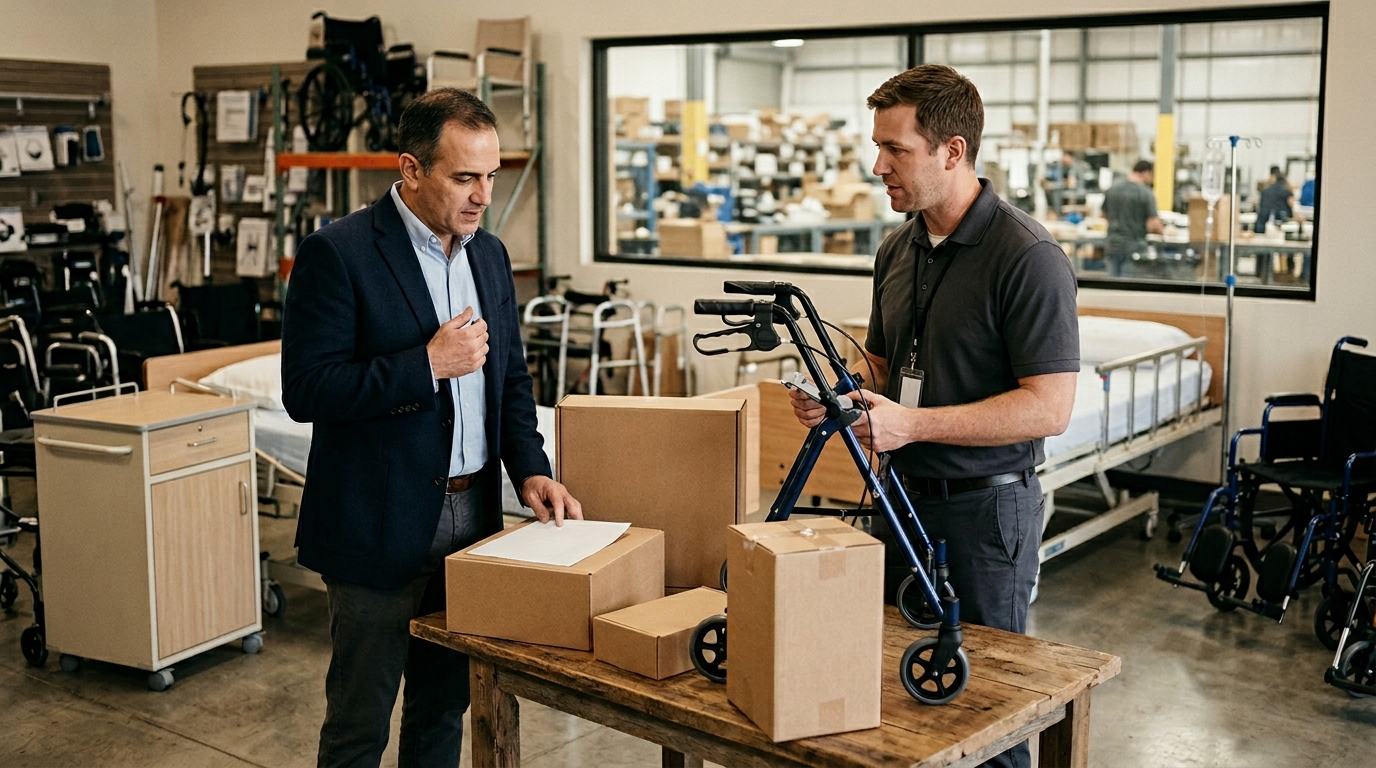
Distributors should ask for stable SKUs, carton dimensions, loading quantities, replacement parts, and sales materials. Importers should push harder on documents, labels, manuals, language versions, and market responsibility. OEM/ODM managers should focus on drawing control, color consistency, logo placement, approval samples, and who pays for tooling or packaging changes. Hospitals should run a product trial with nursing staff before standardizing the bed across rooms.
YOYI CARE’s official brand information references ISO13485:2016 quality management, CE and FDA-related certification references, a Chinese Medical Device Production License, OEM/ODM customization, and more than 60 patents. Those facts are useful during early supplier screening, but you should still request current copies of documents for the exact bed model and destination market.
A simple scorecard keeps the buying team honest:
| Score area | Weight suggestion | Pass condition |
|---|---|---|
| Certification and documents | 25% | Current, model-relevant, market-relevant files |
| Bed function fit | 20% | Functions match nursing home or distributor channel |
| Production and QC | 20% | Clear inspection steps and sample approval control |
| Motor and parts support | 20% | Replaceable parts, named components, support path |
| OEM/ODM fit | 15% | Branding and packaging process is documented |
Should buyers visit the factory?
Yes, for larger distributor programs or private-label launches. A factory visit shows production flow, inspection habits, warehouse control, and how staff handle nonconforming products. If travel isn’t practical, request a live video audit, production-line photos for the exact bed type, and a third-party pre-shipment inspection.
Don’t ask only sales questions on that visit. Ask the quality manager how a failed bed is tagged. Ask the warehouse team how motor batches are stored. Ask the packing team what damage they see most often. You learn more from the answers that aren’t in the catalog.
FAQ
Which bed certifications matter?
ISO 13485, CE-related files, FDA-related documents, product test reports, and local market labeling rules matter most. Ask for current copies tied to the exact bed model, not only a company brochure.
Is FDA registration enough?
No. FDA registration or listing language doesn’t automatically prove safety, performance, or market suitability. Importers should review the full regulatory path with a qualified consultant.
Manual or electric bed?
For nursing homes, electric beds usually work better because staff adjust beds often. Manual beds can fit budget tenders, backup inventory, or low-adjustment settings.
What should distributors inspect?
Inspect bed functions, motors, handsets, brakes, side rails, labels, manuals, cartons, spare parts, and loading condition. A third-party pre-shipment inspection is wise for container orders.
Can OEM bed branding change?
Yes, common OEM options include logo placement, packaging, manuals, labels, colors, and selected accessories. Structural or electronic changes need engineering review and sample approval.
If you’re building a nursing home bed line for distribution, import, hospital procurement, or private-label sales, start with the supplier checklist before price negotiation. YOYI CARE can help you review bed functions, OEM/ODM options, certification references, and spare-parts planning so your next hospital bed program is easier to sell and easier to support.


