

Choose a power wheelchair manufacturer by proving four things before you discuss price: regulatory fit, repeatable production, controlled OEM/ODM changes, and after-sales accountability. A supplier that can build a nice sample but can’t document ISO13485 scope, battery compliance, spare-parts support, and batch QC will put your brand in the service queue six months after launch.
Power Wheelchair Manufacturer Fit
1. Verify ISO13485 scope, CE/FDA documentation, and export history for each target market.
2. Request a sample built against your battery, controller, packaging, logo, and carton spec.
3. Audit production, incoming QC, final inspection, and spare-parts support.
4. Fix warranty, lead time, change-control, and after-sales terms before deposit.
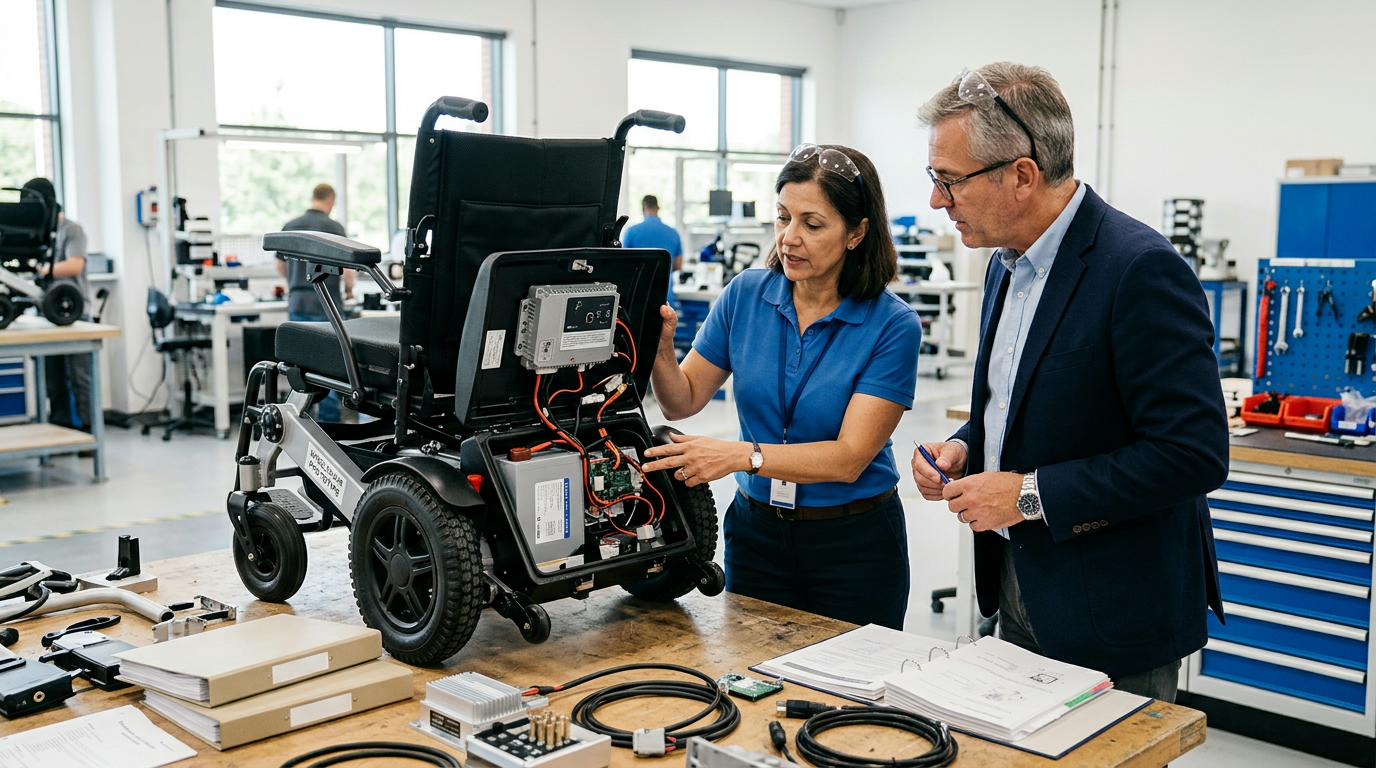
Two chairs can look identical in a catalog. Same black joystick. Same folding frame. Same “lightweight travel” claim. Then the container arrives, your dealer opens 20 cartons, and small differences start costing money: one charger plug doesn’t match the destination market, one carton label is missing the importer name, and one batch has a slightly different controller response from the sample you approved.
That’s why fit comes before price.
This guide is for B2B buyers sourcing standard and custom electric wheelchairs for distribution, private label, care-facility procurement, and hospital purchasing. It doesn’t cover complex rehab power chairs such as the Permobil F5 Corpus or Sunrise Medical QUICKIE Q700 M, which are usually sold through clinician-driven seating channels. If your project is a foldable power chair, travel chair, steel-frame institutional chair, or private-label mobility SKU, the factory questions below apply directly.
| Buyer scenario | Better manufacturer fit | Reject if |
|---|---|---|
| Importer launching first private-label SKU | Existing OEM platform with light branding | Factory pushes ODM before you have sales data |
| Distributor replacing a weak supplier | Stable model family with spare-parts files | Supplier won’t share serial traceability |
| Hospital or care-facility program | Durable frame, clear maintenance path | Only showroom videos are available |
| Healthcare device brand | ODM support with written change control | Engineering changes happen through chat messages |
Once you know the channel, compare YOYI CARE’s custom electric wheelchair manufacturer range with the same fields from other factories: frame material, battery options, controller settings, branding scope, packaging options, and service parts. YOYI CARE was founded in 2013 and its official site references ISO13485:2016, CE, FDA, Chinese Medical Device Production License, OEM/ODM customization, and 60+ patents. Those facts are a useful starting file, not the whole supplier audit.
A power wheelchair manufacturer that refuses to name the target user segment is guessing. “For everyone” is usually code for “we haven’t tested the channel.” A travel chair has different buyer anxiety from a care-home chair. A distributor selling against Pride Mobility Jazzy Carbon or WHILL Model C2 will care about folded size, battery removal, carton damage, and demo handling. A facility buyer will care more about cleaning, repair access, frame wear, and whether staff can get parts without chasing five contacts.
Certification Proof
Treat certificates as the first filter. For U.S. buyers, a powered wheelchair has a specific device identity: use the FDA powered wheelchair product classification as a starting point because the FDA lists product code ITI and 21 CFR 890.3860 for powered wheelchairs. For quality systems, ISO describes ISO 13485:2016 as the medical-device quality management standard for regulatory purposes.

Ask a simple question early: “Which documents apply to this exact model for my exact market?” If the answer is a bundle of unrelated PDFs, slow down. The name on the certificate should match the legal manufacturer or the documented supply chain. The address should match the production site. The product scope should make sense for electric wheelchairs, power wheelchairs, or mobility devices, not a broad phrase that hides what was actually audited.
What certifications should buyers check?
Buyers should check ISO13485 scope, CE documentation for the target market, FDA registration/listing or 510(k) status when applicable, battery transport documents, and model-level test reports. The name on each file should match the legal manufacturer, address, product family, and intended market. A logo claim on a website isn’t enough.
Here’s the file request we’d use before a sample order:
- ISO13485 certificate: issuer, expiry date, site address, and scope
- CE file: Declaration of Conformity, applicable regulation route, and supporting test files
- FDA file: registration/listing details or 510(k) status where applicable
- Battery pack file: UN38.3 summary, SDS/MSDS, charger specs, and pack label
- Label pack: user manual, carton marks, warnings, serial number format, and spare-parts list
YOYI CARE’s public site references ISO13485:2016, CE, FDA, and Chinese Medical Device Production License. In an OEM/ODM project, ask the sales and compliance team to map those references to the chosen model, destination market, importer role, and label owner. That one mapping exercise catches half the mistakes buyers usually discover after packaging artwork is already done.
Be careful with the word “FDA.” In sourcing conversations, it may mean factory registration, device listing, past export experience, a test report, or a cleared file. Those are different things. Your compliance advisor should confirm which route applies to your market and claim set.
Factory Capacity
Capacity is where brochure claims get expensive. A factory can have a busy production floor and still miss your shipment if your battery pack, controller, carton, or upholstery material is waiting on a sub-supplier. A clean production answer includes dates, owners, inspection gates, and material risk. “No problem” is not a production plan.
How do you verify capacity?
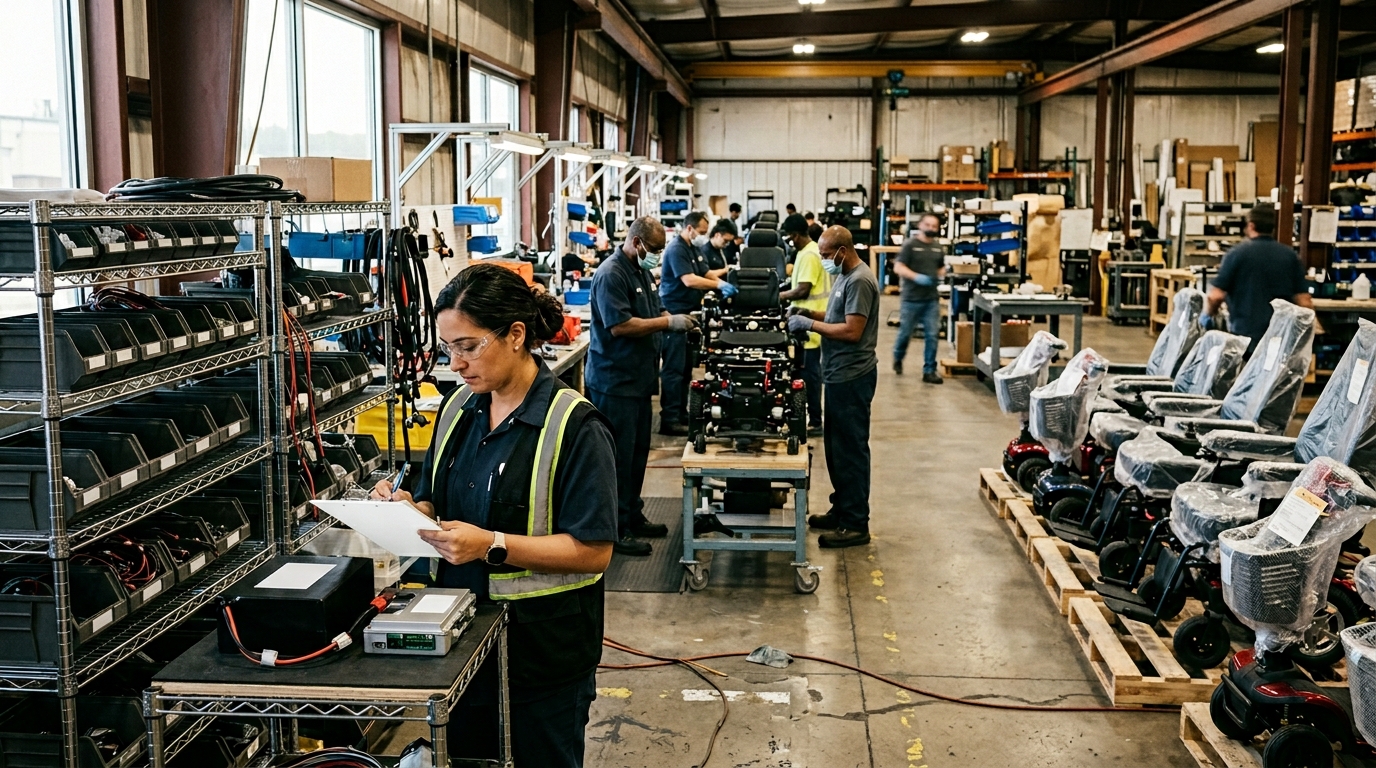
Verify capacity by tracing one live or recent order from material receipt to carton loading. Ask for line schedules, incoming inspection records, final QC forms, packing photos, and export booking proof. During a video audit, make the supplier follow one serial number through frame, electronics, upholstery, and finished-carton records.
YOYI CARE’s official site references more than 200 employees, a factory address in Yongkang, Zhejiang, and assembly-line production. For your audit, translate those facts into a dated line plan: which line builds your frames, who signs incoming inspection, where joystick and battery checks happen, and where finished cartons wait for export pickup.
| Factory claim | Proof to request |
|---|---|
| “We can produce your order” | Model-level line schedule and material arrival plan |
| “QC is strict” | Incoming, in-process, and final inspection forms |
| “We export often” | Recent packing list format, carton marks, and export document sample |
| “Spare parts are available” | Parts list with item codes and reorder process |
A pilot order should test the factory system, not just the chair. Ask the supplier to build the pilot with your approved carton, manual language, logo placement, color accents, battery option, and controller setting. If the factory asks to “fix packaging later,” treat that as a risk. Packaging errors are boring until customs, a distributor warehouse, or a hospital receiving team rejects the carton.
The most honest factories will tell you where capacity gets tight. That might be battery packs before holidays, powder coating during rainy weeks, or upholstery color matching when you choose a non-standard material. You want that honesty before the purchase order, when you can still change the plan.
OEM/ODM Customization
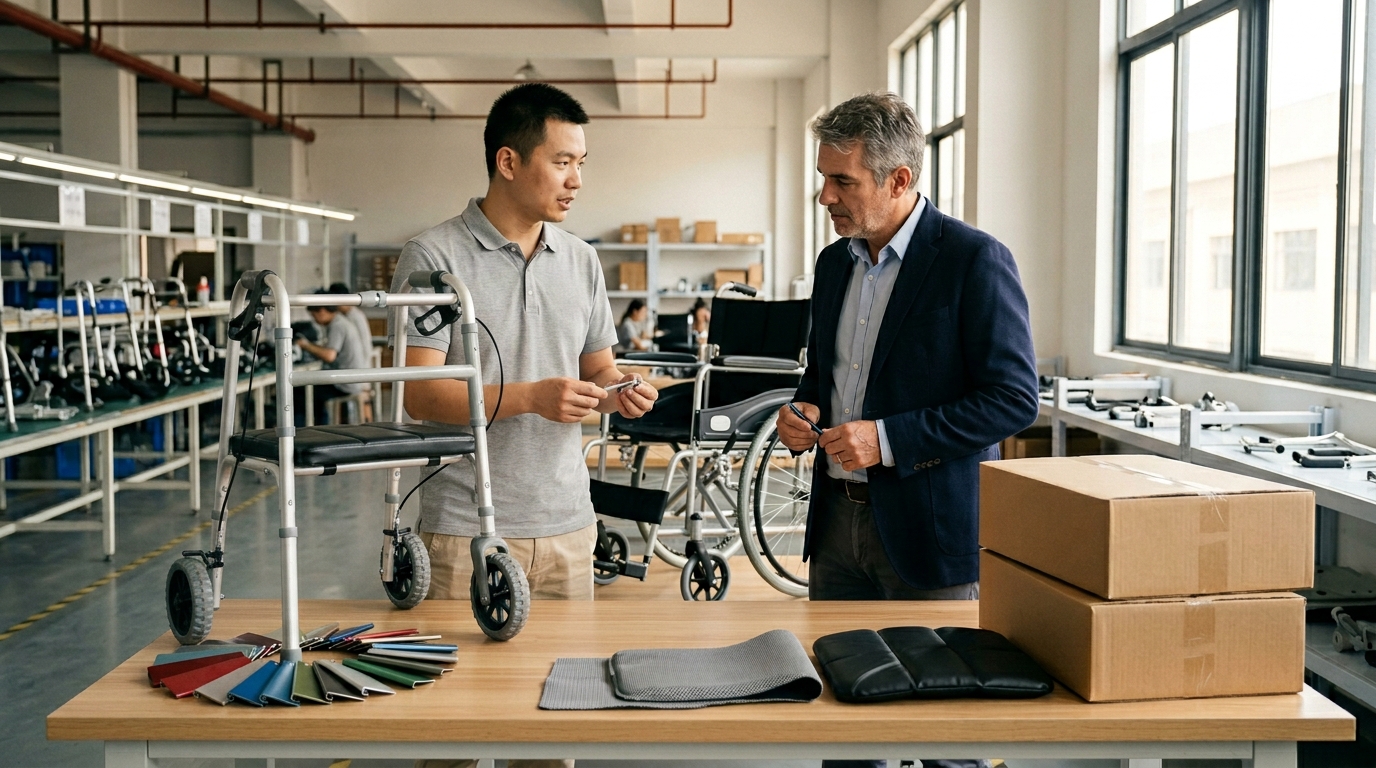
OEM is fastest when your buyer wants a proven frame with your logo, color, packaging, manual, and carton marks. ODM is right when your channel needs a distinct frame geometry, controller setting, accessory set, or cost target that a catalog SKU can’t meet. A first-time importer should usually start with an OEM pilot, collect dealer feedback, then move into ODM once the sales data tells you what to change.
Is OEM different from ODM?
Yes. OEM usually applies your brand and market files to an existing product platform. ODM changes the product itself: frame, electronics settings, accessories, packaging structure, or other engineering choices. OEM is lower-risk for a first purchase order; ODM makes sense when you have demand data and a clear spec.
YOYI CARE lists OEM/ODM options such as cushion material, color accents, logo methods, battery capacities, and controller program settings. If your travel channel needs a lighter hero SKU, compare a carbon fiber electric wheelchair with aluminum and steel options before approving a private-label catalog. Weight sells quickly in a showroom, but service access and material cost still decide margin.
| Custom area | OEM question | ODM question |
|---|---|---|
| Branding | Where can my logo appear? | Can the frame shape support brand identity? |
| Battery | Which capacities are already tested? | Do we need a new pack position or case? |
| Controls | Which controller settings are standard? | Who validates new settings before shipment? |
| Packaging | Can my carton and manual be applied? | Does packaging need new drop or pallet testing? |
The golden sample should become the control point for every later batch. Keep one sample with the factory and one with your team. Photograph the controller, battery label, charger label, frame finish, upholstery, serial number plate, carton, and accessory pack. Then put the approval rules in writing.
One small example: a buyer approves a black cushion with a stitched logo. Bulk production arrives with a heat-transfer logo because someone at the factory thought it looked cleaner. The chair still works. The brand program doesn’t. That is why cosmetic changes need the same approval discipline as motor, brake, or controller changes.
Quality, Warranty, Parts
The cheapest wheelchair in the container can become the most expensive chair in your warehouse. If a joystick fault takes three weeks to diagnose, your dealer doesn’t care that the ex-factory price was attractive. If a replacement charger has no clear part code, your support team will spend more time identifying the part than solving the claim.
What happens after shipment?
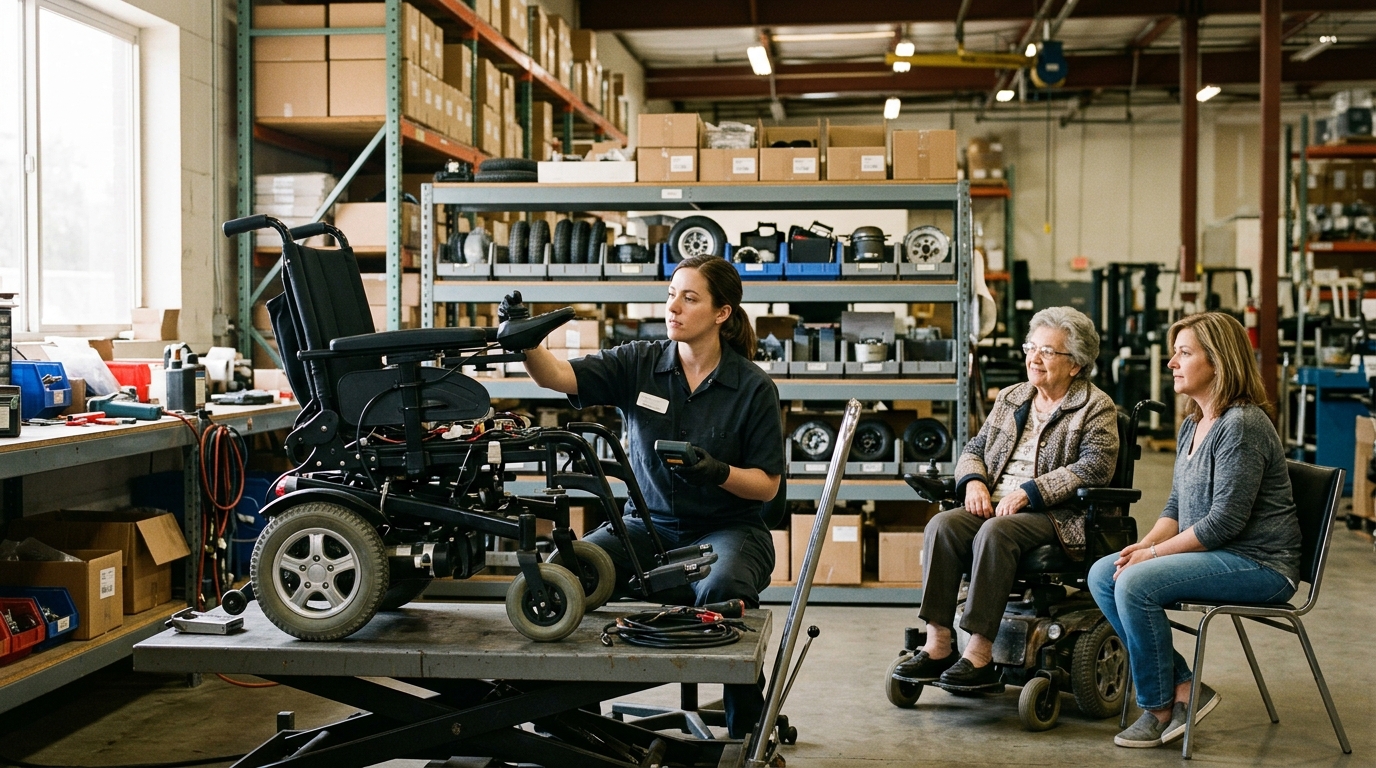
After shipment, your real cost is determined by response speed, spare-parts availability, claim evidence, and repair instructions. Ask who diagnoses joystick, charger, motor, battery, frame, and upholstery issues. Ask whether replacement parts ship with bulk orders or as separate service kits. Then write the process into the purchase agreement.
Warranty terms need more than a duration. Ask when the warranty starts, what evidence is required, who pays freight for parts, which failures are excluded, and how the supplier handles repeat defects. A serious supplier can explain the claim path without asking you to wait until a problem happens.
Run a pilot batch inspection like a distributor, not like a showroom visitor:
- Check charger plug, voltage label, and destination-market language
- Fold and unfold every sample unit several times
- Test joystick response, brake release, and parking behavior on level ground
- Remove and reinstall the battery pack according to the manual
- Review upholstery stitching, cushion fit, and logo position
- Confirm serial number format on chair, carton, and paperwork
- Open the accessory pack and compare it with the packing list
- Photograph carton condition after handling
Carbon fiber is attractive for travel and showroom demos because weight is easy to explain. Steel can tolerate rough rental and institutional handling at a lower material cost, though freight and user handling may suffer. Aluminum often lands in the middle. If your buyer compares against Pride Mobility Jazzy Carbon or WHILL Model C2, measure folded dimensions and battery handling before you argue price.
Red flags that usually predict service work:
- The sample uses one controller brand and the bulk order switches without written approval
- The battery label changes between quote and PI
- The supplier can’t give serial-number traceability by carton
- Warranty starts at factory shipment date for every market, with no allowance for importer storage time
For hospitals and care facilities, spare parts matter even more than branding. Procurement teams may accept a limited model range if service parts are clear, reorderable, and named consistently. A good parts file includes photos, item codes, compatibility by model, and replacement notes. Your warehouse team should be able to identify a brake handle or joystick cable without sending ten photos back to the factory.
Commercial Terms
Commercial terms decide whether a good factory becomes a profitable program. Price per unit is one line. Your landed cost also includes spare parts, carton strength, inspection, freight volume, documentation errors, payment timing, claim handling, and any rework needed after arrival.

Who shouldn’t use this guide?
This guide doesn’t fit retail buyers choosing a chair for one person, clinicians specifying complex rehab seating, or dealers buying from a domestic distributor. It is for B2B teams that carry inventory, manage import paperwork, own warranty claims, and need repeatable OEM/ODM supply.
When two power wheelchair manufacturer quotes sit within 5%, choose the one with clearer post-shipment math. A cheaper chair with unclear battery paperwork, weak cartons, and vague spare-parts pricing is rarely cheaper after the first claim cycle. Ask for Incoterms, packing dimensions, loading plan, payment terms, inspection access, service-kit pricing, and part reorder process before you negotiate the final unit price.
A useful RFQ should include these fields:
- Destination market and importer role
- Model type, frame material, and intended channel
- Battery option, charger plug, and transport paperwork needs
- Logo placement, color accents, manual language, and carton artwork
- Sample approval steps and pilot order expectations
- Forecast bands by quarter, without forcing an unrealistic MOQ promise
- Incoterms, packing method, spare-parts kit, and inspection point
- Warranty claim flow, response time target, and evidence requirements
Use a 100-point supplier score if your team is comparing several factories:
| Score area | Points |
|---|---|
| Compliance proof and model-level files | 25 |
| Production control and inspection records | 20 |
| OEM/ODM fit for your channel | 20 |
| Warranty, parts, and service process | 20 |
| Commercial clarity and export support | 15 |
Ask for a change-control clause. If the manufacturer changes controller, charger, battery cell, brake, tire, carton, manual, or accessory pack, you approve the change in writing before bulk production. This sounds basic. It prevents painful calls after your dealer says the second batch “feels different” from the sample.
Lead time should be a calendar with gates: sample approval, material purchase, pilot build, pre-shipment inspection, and vessel booking. Avoid exact promises until the model, quantity band, custom scope, and destination paperwork are confirmed. Without that, your launch date becomes a polite guess.
FAQ
What is a power wheelchair manufacturer?
A power wheelchair manufacturer designs, assembles, tests, and supplies battery-powered wheelchairs for medical mobility channels. For OEM/ODM buyers, the manufacturer should also support branding, documentation, spare parts, and repeat batch control.
How do I verify OEM capability?
Ask for a sample using your logo, packaging, manual, and battery option, then compare it with the written spec. Request batch photos, inspection records, and change-control terms before mass production.
Which certificates matter for importing?
Start with ISO13485 scope, CE documentation for Europe, and FDA registration/listing or 510(k) status where applicable in the U.S. Match each file to the exact model, factory address, legal manufacturer, and destination market.
Is ODM better than OEM?
ODM is better when you need a distinct product and have demand data. OEM is better for faster launch, lower engineering risk, and first orders where channel feedback still matters.
What should buyers ask YOYI CARE?
Send YOYI CARE your target market, model type, frame material preference, battery requirements, branding scope, forecast bands, and warranty expectations. Ask which certifications and test files apply to each selected model.
At YOYI CARE, we can review your target market and product brief against current electric wheelchair options, then confirm which OEM/ODM paths make sense. For the fastest evaluation, send a one-page spec with frame material, folding requirement, battery preference, logo placement, packaging language, forecast band, and destination port.


