

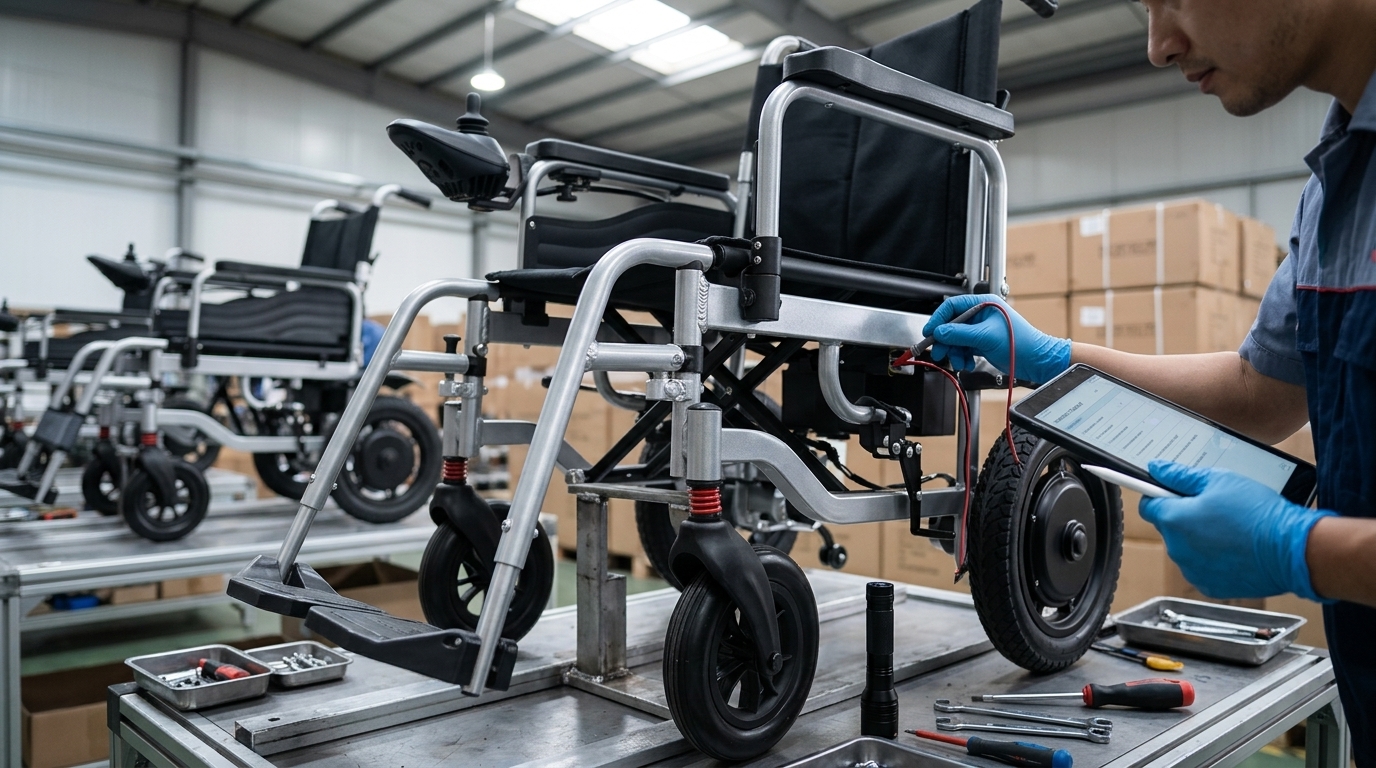
Electric wheelchair quality control should confirm safety, function, packaging, and traceability before a bulk order leaves the factory. For distributors, importers, OEM/ODM managers, and hospital procurement teams, the real risk isn’t one imperfect sample; it’s 300 units with the same hidden brake, weld, battery, or carton problem.
Electric Wheelchair Quality Control
Electric wheelchair quality control for bulk buyers should verify seven areas before shipment: frame welding, controller response, electromagnetic brakes, battery and range, tires and wheels, folding parts, and export packaging. The buyer should also check traceable QC records, charger labels, spare parts, carton drop results, and CBM against the purchase order.
| QC Area | What To Check | Shipment Blocker |
|---|---|---|
| Frame | Welds, alignment, paint coverage, load points | Cracks, loose joints, twisted frame |
| Controller | Joystick response, speed modes, reverse, turning | Delay, lurching, uncontrolled movement |
| Brakes | Electromagnetic lock, freewheel reset, slope hold | Brake slip or failure to lock |
| Battery | Capacity label, charger match, range test, transport docs | Wrong battery, unsafe pack, poor range |
| Wheels | Tire wear, rim runout, caster swivel, hub motor noise | Wobble, rubbing, poor tracking |
| Folding | Lock pins, hinge play, repeated fold/unfold | Loose locking or hand-pinch risk |
| Carton | Drop result, foam, accessories, CBM, markings | Damaged unit or wrong carton data |
Before you compare one electric wheelchair supplier with another, ask for the actual QC plan used on your order. A polished sample tells you the factory can build one good chair. A signed inspection record tells you whether the factory can repeat it.
A practical rule: treat safety functions as zero-acceptance items. Cosmetic issues can be graded by AQL. Brake failure, wrong charger, cracked weld, exposed wiring, or mismatched battery label should stop the shipment.
For private-label programs, the QC checklist should be locked before mass production. If you approve a sample with a 24V lithium battery, a specific controller response curve, and a certain carton size, those details belong in the purchase order. Memory is a poor quality system.
Frame Welds And Load Points
Paint hides sins. That’s why frame inspection should start before coating, especially on steel and aluminum frames. Look at the weld bead around the motor bracket, folding hinge, caster fork, footrest mount, seat frame, and anti-tip wheel bracket. These areas take repeated load when a user crosses a threshold, turns on a ramp, or transfers from a bed.
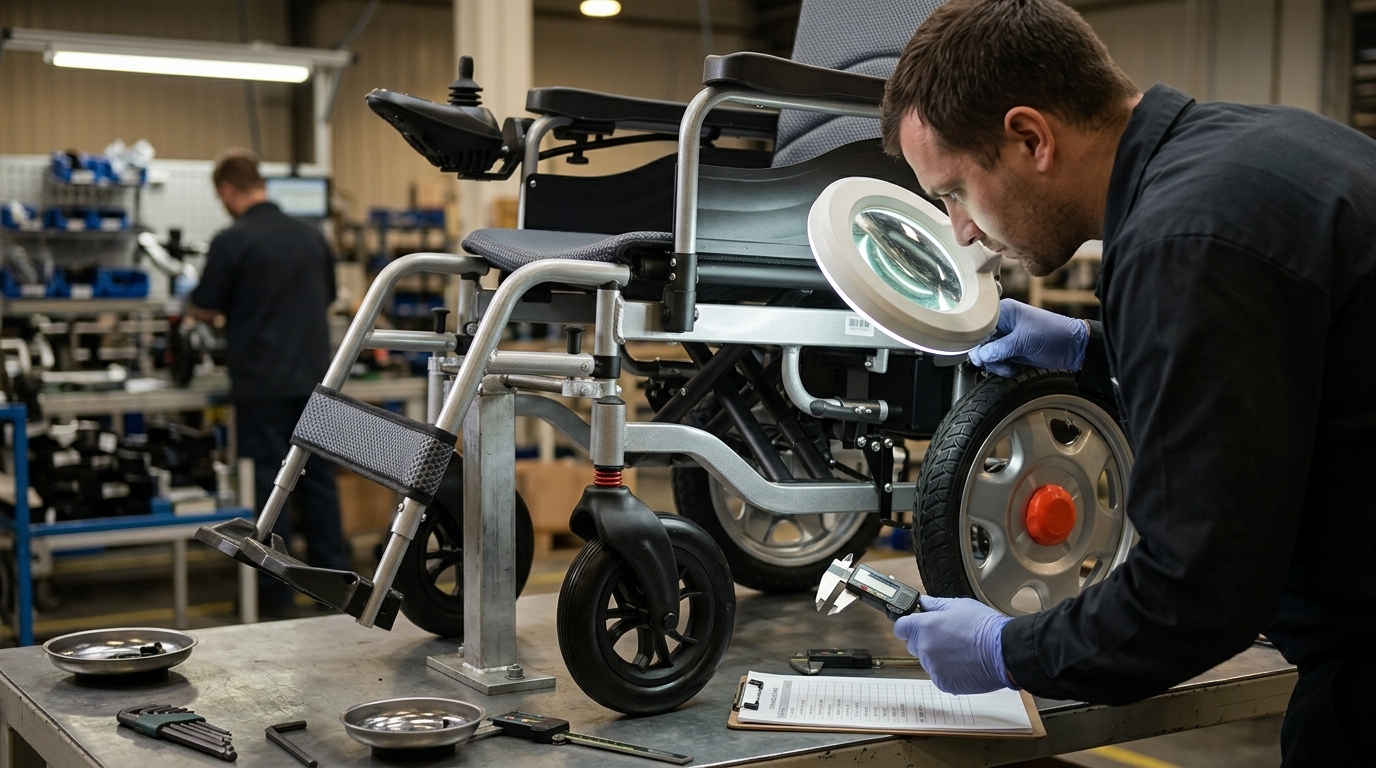
What should your inspector look for? Porosity, undercut, burn-through, cold welds, spatter, and inconsistent bead width. A small pinhole near a motor mount can look harmless in a pre-shipment photo. After three months of vibration, it becomes a warranty case with freight costs attached.
Use simple checks first:
- Confirm left/right frame symmetry on the sample and production units.
- Measure wheelbase and seat frame alignment against the approved drawing.
- Check that folding hinges sit square and close without forcing.
- Push down on armrests, footrests, and backrest joints to feel for flex.
- Review material thickness where the product spec names it.
If you’re working with a custom electric wheelchair manufacturer, ask how the factory controls welding fixtures between orders. OEM/ODM changes often start small: a new bracket, a different cushion base, a battery box adjustment. Each change can shift frame stress, even when the chair looks the same in catalog photos.
For a first bulk order, don’t rely on finished-product inspection alone. Ask for in-line frame photos or video before painting. It’s a plain request, but it saves arguments later because the raw weld is still visible.
Controllers, Brakes, And Wiring
A wheelchair can look perfect and still feel wrong in the first five seconds of driving. The joystick moves forward. The chair waits. Then it jumps. That small lurch is exactly the kind of defect a hospital buyer notices during trial use.

Controller QC should test every speed mode, forward and reverse movement, left/right turns, stop response, horn if included, battery indicator, and fault alarm. If your spec names a controller brand or model, such as PG Drives Technology VR2 or R-net, confirm the installed unit matches the approved BOM. If the spec allows an equivalent controller, define the response curve and connector layout before production.
Use this functional test pattern on sampled units:
- Power on and check display or indicator lights.
- Drive forward at low, medium, and high speed.
- Reverse in a straight line.
- Turn left and right in a tight radius.
- Release the joystick and confirm clean stop behavior.
- Switch to manual freewheel mode, then reset to powered mode.
- Repeat after charger connection and disconnection.
Electromagnetic brakes deserve their own line item. They should release when powered driving starts, lock when the joystick returns to neutral, and hold the chair on the slope defined in your product specification. Don’t let the factory test brakes only on a flat workshop floor. Flat floors make weak brakes look better than they are.
Wiring QC is less exciting, which is why it gets missed. Check connector seating, strain relief, cable ties, charger port fit, motor wire routing, battery polarity marking, and controller box sealing. A cable rubbing against a folding joint is a future failure. You can almost hear the warranty email being typed.
For export markets, certification references are part of the file, but they don’t replace unit-level QC. YOYI CARE’s official site references ISO13485:2016, CE, FDA-related certification, OEM/ODM customization, and 60+ patents. Still, we treat certificates as the entry ticket. The production lot has to pass.
Battery Range And Chargers
Battery QC is where bulk buyers lose money quietly. A carton arrives with the right chair, the right color, the right logo, and a battery that underperforms by 30%. Nobody sees it at customs. The complaint starts when the end user can’t complete a normal day.
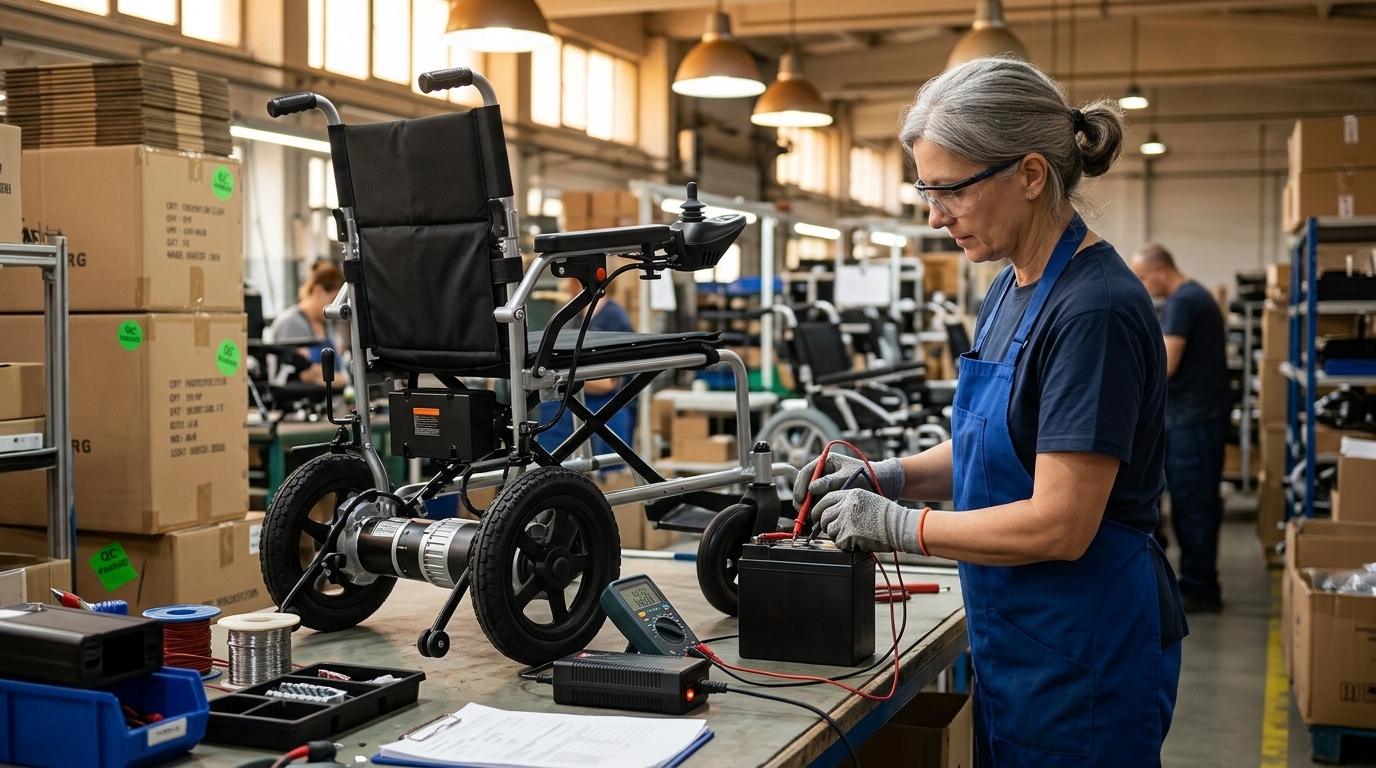
Check four things: battery identity, charger match, range test method, and transport documents.
| Battery Item | Buyer Check | Why It Matters |
|---|---|---|
| Label | Voltage, Ah, Wh, chemistry, production date | Prevents spec substitution |
| Charger | Output voltage/current, plug type, safety label | Avoids wrong charging profile |
| BMS | Overcharge, over-discharge, short-circuit protection | Reduces battery failure risk |
| Range | Payload, surface, speed, tire pressure, test route | Stops inflated range claims |
| Shipping File | UN38.3 test summary, MSDS/SDS, battery mark | Supports export and carrier review |
Range numbers are easy to make look good. Use the same payload, speed mode, floor type, tire pressure, and start/stop pattern used for the approved sample. If the catalog range was tested with a 75 kg load on a smooth indoor surface, don’t compare it with a production test using a lighter load or a slower speed.
For lithium battery shipments, the U.S. Pipeline and Hazardous Materials Safety Administration says lithium cells and batteries offered for transport must have passed UN Manual of Tests and Criteria Section 38.3, and manufacturers must make test summaries available on request. That’s not a small paperwork detail when you’re booking air freight or working with a cautious carrier.
Lead-acid batteries still appear in cost-sensitive projects. They’re heavier and usually less attractive for portable folding chairs, but some distributors prefer them where replacement channels are already built around lead-acid service. Lithium works better when the buyer needs lower weight, cleaner packaging, and stronger portability. The tradeoff is stricter shipping documentation and tighter charger control.
Ask for one complete charging cycle on sampled units before final inspection. Check whether the charger gets unusually hot, whether the indicator changes correctly, and whether the chair powers on cleanly after charging. Small test. Big signal.
Wheels, Folding, And Packaging
Tires and wheels decide how the chair feels before the buyer reads a single spec. Inspect tire fit, tread damage, pneumatic pressure if applicable, solid tire deformation, rim runout, caster swivel, axle nut torque, and hub motor noise. A slight wheel wobble on a test bench becomes obvious in a clinic hallway.
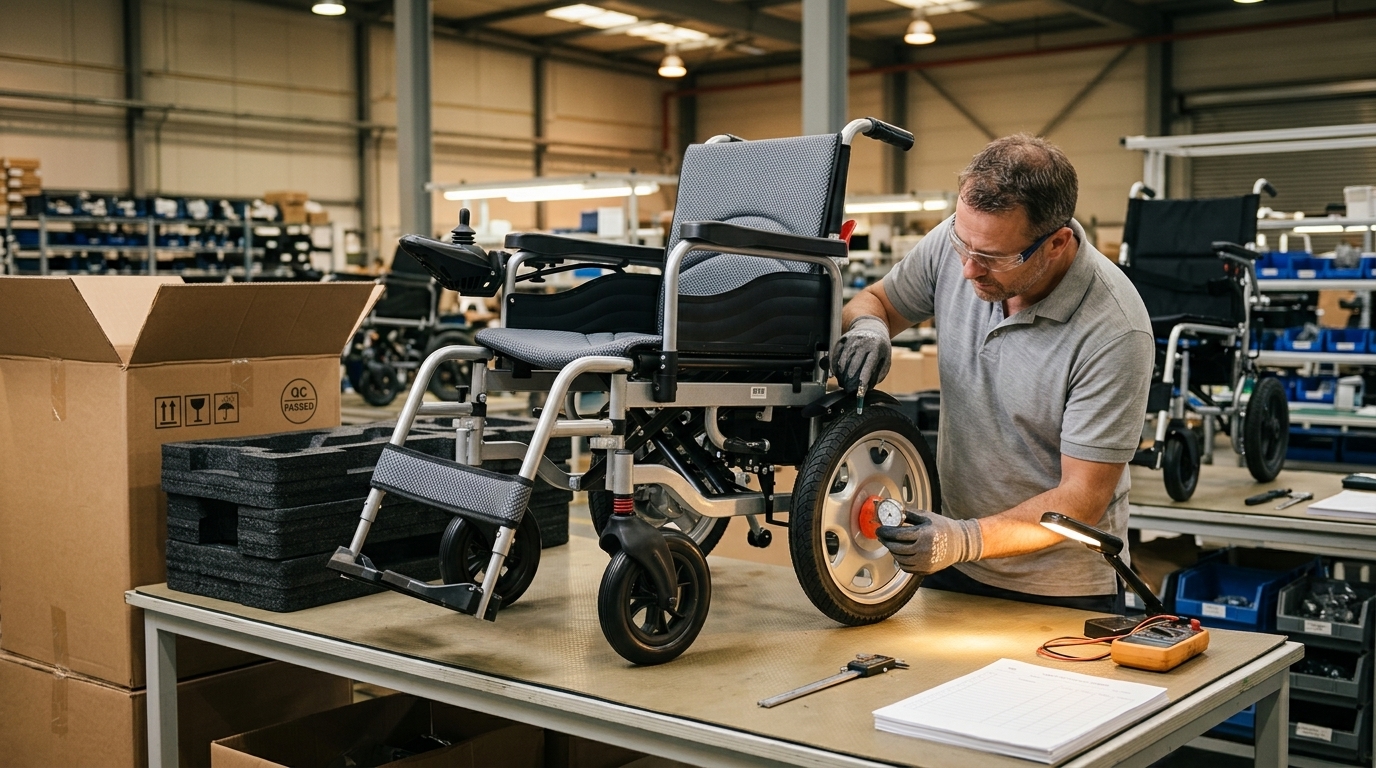
For folding models, run repeated fold/unfold checks on sampled units. Ten cycles during pre-shipment inspection is a sensible floor for basic screening; new models should go through a longer validation plan agreed during sample approval. Watch the lock pin. Watch the hinge. Watch the user’s fingers. That’s where the bad designs reveal themselves.
If you’re sourcing a carbon fiber electric wheelchair, add checks for surface scratches, insert bonding, resin pooling, and delamination around drilled or fastened areas. Carbon fiber can reduce weight, but it punishes sloppy insert design more than steel does. For a foldable aluminum electric wheelchair, pay closer attention to hinge wear, frame alignment, and surface coating after repeated folding.
Packaging is not an afterthought for bulk buyers. It affects damage rate, container loading, replacement parts, and landed cost.
Check these before balance payment:
- Carton dimensions, gross weight, net weight, and CBM.
- Foam position around joystick, wheels, footrest, and frame corners.
- Accessory bag contents against the packing list.
- Manual, charger, tool kit, and spare parts agreed in the PO.
- Barcode, model number, color, voltage, destination label, and warning marks.
- Carton drop or transport test result for the agreed shipping method.
ISTA says its 3-Series protocols simulate damage-producing motions, forces, conditions, and transport sequences, with Procedure 3A covering parcel delivery shipments up to 150 lb / 70 kg. For electric wheelchairs, choose the test around the packed weight and route. A light folding chair shipped by parcel needs a different packaging test than a palletized container order.
CBM deserves a hard check. Two extra centimeters on one carton side can reduce the number of units in a 40HQ container. That turns a “cheap” packaging change into a landed-cost problem.
QC Records Before Payment
The best time to find a defect is before the balance payment. The second-best time is never, because after shipment you’re paying with spare parts, refunds, reputation, and slow email chains.

Ask your factory for a QC packet, not just inspection photos. For YOYI CARE OEM/ODM orders, this is the kind of file serious buyers usually want to review before release:
| Record | What It Should Show |
|---|---|
| Approved sample sheet | Model, color, battery, controller, packaging, logo |
| BOM/version record | No unapproved substitution |
| Incoming material check | Frame tubes, motors, batteries, controllers, chargers |
| In-line inspection | Welding, frame alignment, coating, assembly checkpoints |
| Function test sheet | Drive, brake, charging, display, freewheel, folding |
| Battery file | Capacity label, charger match, transport documents |
| Packing report | Carton size, CBM, accessories, marks, drop result |
| Corrective action record | Defects found, fix method, recheck result |
For U.S.-regulated medical device quality systems, the FDA Quality Management System Regulation became effective on February 2, 2026 and incorporates ISO 13485:2016 by reference. That matters for manufacturers and importers because quality control has to connect with design, production, records, and risk management, not sit as a final photo album after the goods are packed.
Small sample orders don’t need the same QC depth as a container order. If you’re buying two demo units, spend the inspection time on function, battery, charger, and documentation. If you’re placing a private-label order for a distributor network, lock the sample, BOM, carton, labels, and after-sales spare parts before mass production starts.
One more point from factory experience: video helps, but it doesn’t replace signed data. A 20-second driving video can miss a wrong charger, a weak brake, or a carton dimension error. Ask for video plus records. That combination works better.
FAQ
What is electric wheelchair QC?
Electric wheelchair QC is the inspection process used to confirm frame safety, driving function, braking, battery performance, folding structure, packaging, and documents before shipment. For bulk buyers, QC should cover both sampled units and production records.
How many units should buyers inspect?
For safety items, inspect every sampled unit with zero tolerance for brake, wiring, charger, or frame defects. For cosmetics and minor finish issues, use an agreed AQL plan based on order size and buyer risk.
Which defects are shipment blockers?
Cracked welds, brake failure, controller delay, wrong battery, exposed wiring, wrong charger, damaged carton protection, and missing transport documents should block shipment. These defects create safety, customs, warranty, or brand risk.
Do certificates replace product inspection?
No. ISO13485, CE, FDA references, and test reports support supplier qualification, but they don’t prove that your actual production lot matches the approved sample. You still need in-line and final QC.
When should QC happen?
QC should happen at incoming material inspection, frame welding, assembly, pre-packing, and final shipment inspection. Bulk buyers should not wait until all cartons are sealed.
For your next bulk order, send YOYI CARE the target market, payload requirement, battery preference, carton limit, branding needs, and inspection standard before sampling. As a China-based medical equipment manufacturer founded in 2013, we can align OEM/ODM specifications, QC checkpoints, certification files, warranty handling, and after-sales spare parts before the first production lot starts.


