

If you are sourcing home care beds for sale, whether for a hospital network, a chain of nursing homes, or a distribution catalog, you already know demand is climbing. The global home nursing bed market is estimated at $2.85 billion in 2026 and expected to rise to $4.34 billion by 2035, growing at a CAGR of 4.8%.
Europe accounts for 36% of the total global supply, followed by Asia-Pacific with 31% and North America with 24%. If you’re selling into either market, you’re sitting on a real opportunity. But picking the wrong manufacturer or the wrong bed type? That creates returns, compliance headaches, and unhappy clients.
Here’s what B2B buyers actually need to know before placing an order.
Why Home Healthcare Beds Are in Such High Demand
This isn’t a short-lived spike. The growth is structural.
The aging population is growing rapidly worldwide. According to the United Nations, the population aged 65 and over is expected to reach 1.5 billion by 2050. With growing age, people are more likely to get diagnosed with chronic diseases that require long-term care and assistance.
Patients and their families are choosing to stay at home. According to a survey by AARP, about 76% of older adults in the United States prefer to receive care at home.
For B2B buyers, this means a growing installed base of home care adjustable beds across both residential settings and long-term care facilities. Around 72% of home care bed installations occur in private home settings, with 28% used in long-term care institutions and rehabilitation facilities.
Electric vs. Manual: Which Home Care Beds Should You Stock?
This is probably the most common question we hear from new distributors. And honestly, the answer is: both—but the mix matters.
The segment of electric beds holds the highest adoption rate, representing 62% of all home care bed sales globally. That’s a clear majority. But manual beds still hold 38% of the market, particularly in price-sensitive regions and for short-term use cases.
Here’s a quick comparison:
| Feature | Electric Nursing Bed | Manual Nursing Bed |
| Adjustment method | Remote, touchscreen, or app | Hand crank |
| Best for | Long-term care, limited caregiver availability | Short-term recovery, budget-focused buyers |
| Caregiver strain | Low | Higher |
| Price point | Higher | Lower |
| Typical buyer | Hospitals, nursing homes, home care retailers | Clinics, emerging-market distributors |
At YOYI CARE, we manufacture both. Our electric nursing beds come with multi-functional features including electric back lift, left and right turning, leg lift and lowering, side-slip prevention, bowel movement assistance, hair washing support, and timed turning—designed to cut caregiver workload by a noticeable margin. Our manual nursing beds provide the same core adjustments: back lift, leg lift, side turning, and hair washing support. They use reliable manual mechanisms designed for durability and long-term performance.
Both lines sit under our full nursing bed manufacturing catalog, and both are available for OEM and ODM customization.
Related article: Main Types of Nursing Bed: How to Choose?
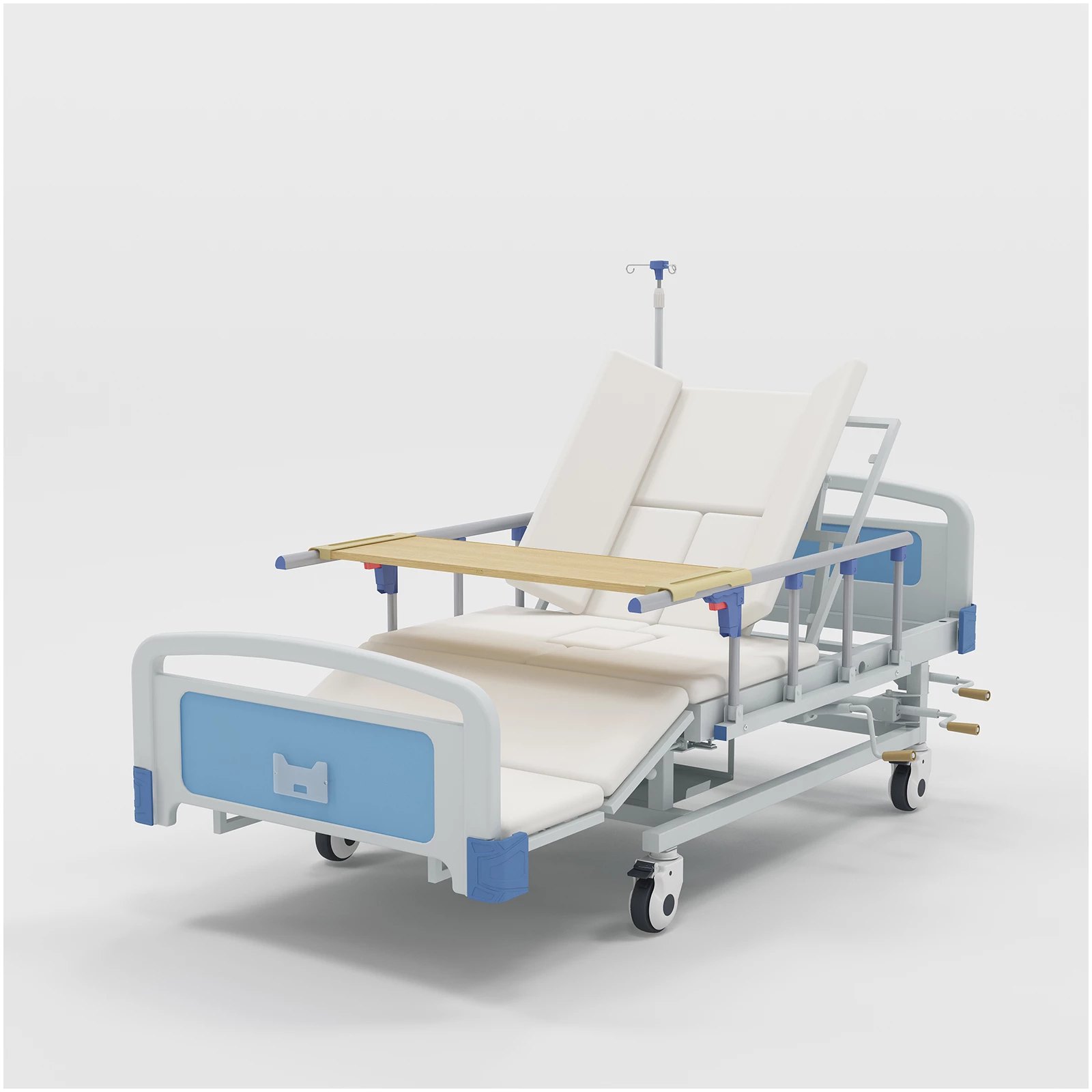

What Features B2B Buyers Should Prioritize
When you’re sourcing home care beds for sale in volume, specs matter more than marketing. Here’s what experienced buyers look for:
- Adjustability range: Controls should include head elevation (0–70°), foot elevation (0–45°), and bed height adjustment. The more positioning options, the more use cases you can cover with a single SKU.
- Safety features: Demand for anti-decubitus mattresses and side rail safety mechanisms has increased by 37% among elderly patients aged 75 and above. Side rails, locking casters, and low-height settings for fall prevention aren’t optional anymore—they’re expected.
- Smart controls: Innovative product launches have increased by 41% since 2023, emphasizing digital controls, fall-prevention sensors, and advanced mobility features. We offer customizable control systems, including voice control, touchscreen, and app remote control. This gives end users modern and intuitive interfaces.
- Material and build quality: We offer two material options, ABS and OSB. We also provide full customization of logos, functionality, and branding to match your market positioning.
Certifications That Open (or Close) Doors
Look, if you’re importing home healthcare beds into Europe or North America without the right paperwork, you’re not going to clear customs.
For the European market, CE marking under the EU MDR framework is non-negotiable. For the U.S., FDA registration is required. And globally, ISO 13485:2016 is the quality management baseline that buyers, regulators, and procurement teams all verify.
YOYI CARE holds ISO 13485:2016, EU CE, U.S. FDA, and Chinese Medical Device Production License certifications. We’ve been a certified manufacturer since 2013—over 12 years of export experience—with 60+ patents backing our product development.
OEM & ODM: Build Your Brand, Not Just Your Catalog
One thing we’ve learned working with distributors across Europe and America: they don’t just want beds. They want their beds. Their logo, their color scheme, their control interface.
That’s where OEM and ODM come in. We customize everything from bed functionality and frame materials to logo placement (laser engraving, crystal stickers, or metal labels) and control systems. MOQ starts at 1 piece for certain models, with production running 30–35 days after deposit.
Whether you’re a first-time importer testing a market or a large distributor scaling a product line, we’ve got a model that fits.
Wrapping Up
The home care adjustable beds market is growing steadily across Europe and America, driven by aging populations, chronic disease prevalence, and a clear consumer preference for home-based care. The home care settings segment is anticipated to record the highest CAGR, driven by an aging population, rising chronic diseases, and technological advancements like telehealth.
For B2B buyers, the sourcing decision comes down to three things: the right product mix (electric and manual), the right certifications (CE, FDA, ISO 13485), and a manufacturer that can truly customize to your brand. Get those right, and you’re not just buying beds—you’re building a competitive product line.
FAQs
What’s the difference between electric and manual home care beds?
Manual beds rely entirely on physical cranks. Fully electric beds put everything at the push of a button. Semi-electric beds split the difference—electric controls for the positions patients adjust most often, manual cranking for height changes. For B2B buyers, electric models make up 62% of global sales, but manual beds remain strong for budget-conscious markets.
What certifications do I need to import home care beds into Europe or the U.S.?
At minimum, you’ll need CE marking for the EU (under the MDR framework) and FDA registration for the United States. ISO 13485:2016 certification is also expected by most procurement teams globally. Always verify certificates through official databases before placing orders.
What’s a typical MOQ and lead time for OEM nursing bed orders?
It varies by manufacturer. At YOYI CARE, MOQ starts as low as 1 piece for certain models. Production typically takes 30–35 days after deposit, though custom OEM orders with unique tooling may take longer. Always confirm lead times in writing.
Are smart features like app control and voice control becoming standard?
Yes, and quickly. Patient safety now ranks as the top purchase criterion for 68% of caregivers surveyed, driven by the integration of IoT and digital health systems. App-controlled and voice-activated beds are increasingly expected, especially in European and American markets.
Why should I source home care beds from a Chinese manufacturer?
China is a global manufacturing hub for medical beds, and sourcing from certified Chinese manufacturers like YOYI CARE gives you access to competitive pricing, deep customization options, and proven export logistics. The key is verifying certifications (CE, FDA, ISO 13485) and checking the manufacturer’s track record—we’ve been exporting for over 12 years with 60+ patents and 200+ employees.
Understanding Nursing Bed Positions and Restraint Practices in Patient Care
https://yoyicare.com/what-is-nursing-bed/


